This blog is for everyone who uses words.

The ordinary-sized words are for everyone, but the big ones are especially for children.


Friday, 7 June 2013

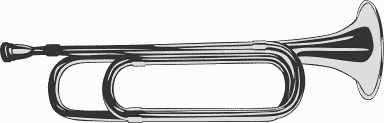
Word To Use Today: bugle.


A bugle is a tube.

bugle brass

If you blow a raspberry down a tube it makes a noise. If you blow harder, it'll make a higher noise.

If you practise for long enough (and someone doesn't wrest your tube from you and jump up and down on it) then eventually you'll be able to play some tunes - but only some. You won't be able to make most of the notes you find on a piano unless you either make holes in the tube, or else you put in some valves so you can make the tube effectively longer or shorter at the press of a button.

And then it won't be a bugle any more.

Bugles used to be used for sending messages in battle. They were good for this because they have a wide bell at the end of the tube, which makes them good and loud for their size.


Here's a Roman bugle, but unfortunately its bell has been broken off.

I have rather a lot of bugles in my garden, but luckily this variety is unlikely to disturb the neighbours.

File:Ajuga reptans - Bugle rampante .JPG
photo by Patrice 78500

The scientists call this bugle Ajuga reptans.

Finally, bugles are beads, usually long glass ones, which are used to decorate fabric:


From war, to weeds, to party clothes.

Now there's word which really deserves a fanfare.

Word To Use Today: bugle. The musical instrument comes from the Latin word buculus, which means bullock, because the first ones were made of horns.
The weed comes from the Mediaeval Latin bugula, and the word for bead turned up in the 1500s. No one is sure where these words came from before that.

Thursday, 6 June 2013

When wasn't isn't: a rant.

So why does I can't help wondering if it wasn't an accident nearly always means I can't help wondering if it was an accident?

Well, don't just sit there: tell me!

What?

You mean you don't know either?

Ah well...

...it may be illogical, but I suppose we manage, on the whole.

Word To Use Today: was. It may seem a bit unreasonable that the past tense of is turns out to be was, but actually was is the one that's been most consistent. It comes from the Old English wesan, to be.

Wednesday, 5 June 2013

Nuts and Bolts: philippic.

'Mrs Ferrars looked exceedingly angry, and drawing herself up more stiffly than ever, pronounced in retort this bitter philippic, "Miss Morton is Lord Morton's daughter." '

I first read Sense and Sensibility more than thirty five years ago, and I've been wondering what a philippic is ever since.

Bitter philippic is such a lovely expression. You can taste the spite of it.

But who was Philip, and why was he so cross?

Well, Philip was Philip of Macedon, who was the father of Alexander the Great. Philip was rather a nasty piece of work, and certainly not the sort of guy to go around bestowing his name to figures of speech.

No, the originator of the philippic was a Greek called  Demosthenes.

Demosthenes' philippics were speeches warning everyone that Philip of Macedon:

Filip II Macedonia.jpg

 was an untrustworthy rotter.

Later, the Roman Cicero used the same format to warn people about Mark Anthony.

History tells us that giving philippics is not at all a healthy thing. Cicero was killed for his, and Demosthenes, although left alone by Philip, committed suicide before Philip's irritated army could get hold of him.

There we are. At last I know what a philippic is: but, to my complete horror, I've discovered that Mrs Ferrers' piece of spite wasn't actually a philippic at all.

Ah well. Jane Austen uses philippic more conventionally in Emma, when she's talking about houses where you can't get a nice bowl of gruel, thin but not too thin. That's good enough for me.

Thing To Do Today But Only If You Live In A Place Where Free Speech Is Completely Safe: let fly with a philippic.

Actually, even so, perhaps it might be safest to stick with describing a historical figure.

Like Philip of Macedon, perhaps.


Tuesday, 4 June 2013

Thing To Do Today But Only In A Good Way: pillage,

I tend to blame the Vikings.

I know that few armies manage to resist the temptation to rob the enemy population (and, very often, everyone else as well); but in England, when we think of pillaging, we usually think of Vikings .

The fact that the last instance of Viking pillage in Great Britain was about a thousand years ago has made no difference at all.

It must be the association with the Vikings, whom the English
imagine as particularly hairy and inclined to wear silly helmets (yes, the horns-on-the-helmets might not have been true, but the myth is, as so often, more powerful than the facts) that has given the word pillage a tinge of comedy and almost of affection.

Viking Warning Black White Line Art Coloring Book Colouring 555px.png


This is why we can pillage a biscuit tin, or a stationery cupboard, or even Wikipedia.

I would still recommend avoiding anyone you see with horns on his helmet, though.

Thing To Do Today But Only In A Good Way: pillage. This word comes from the Old French pillage from piller, to despoil. Before that it may come from the Late Latin piliō, which probably comes from pilus, hair (see Vikings) or from the Old French peille, which means rag, from the Latin pīleus, which means felt cap (don't see Vikings).


Monday, 3 June 2013

Spot the frippet: foil.

Here's an easy thing to spot: just look in a grocer's shop or supermarket near you and you'll find foil-wrapped chocolate, crisps, football stickers...

If that's too boring (and it is), then you could look in a mirror: the backing of the glass is a bit of metal foil. The same principle is sometimes used to make jewels sparklier.

As it's Spot the Frippet day then you could always look out for the traditional pairing of the beautiful young lady with the plain friend. The friend is there to highlight the beauty of the other, in other words to be his or her foil.

A doubling-back sort of foil happened when a hunted animal retraces its steps in order to throw hunters off the scent.

A trefoil is used as a symbol by Girl Guides:


User:Kintetsubuffalo

A quatrefoil is an architectural form much used in Gothic architecture:

File:Quatrefoil-Architectural-alternate.svg
Illustration by Anonmoos.

And a cinquefoil is a particularly annoying weed in my garden:

File:Sulphur cinquefoil (St Joseph I).JPG
Fungus Guy


Apart from that, a foil is a sword with a safety button on the end.

Word To Use Today: foil. The hunting and baffling word (foiled again!) comes from the Old French fuler, to tread down. The thin sheet also comes from Old French, from foille, and before that from folia, the Latin for leaves.

No one knows where the word for sword comes from, but perhaps it's because any attempt to stab someone is foiled by the button on the end.

Sunday, 2 June 2013

Sunday Rest: Word Not To Use Today: usufruct.

Well, this is a word of two halves. Unfortunately both of them are horrible.

We kick off with usu, which sounds like a frilly skirt worn exclusively for going out to get drunk, and then dive into fruct, which sounds like the reaction of a maiden aunt to the sight of someone wearing a usu.

She saw me in my usu, right, and she was well fruct.

Now, if only usufruct did mean something as interesting as that then it wouldn't be so bad, but the word usufruct is not only nasty and ridiculous, but boring, too.

A usufruct allows one to use a property not one's own, and to make money from it, as long as the property itself isn't diminished.

It's okay, you can wake up, now.

Really.

Because I'm certainly not going to use the word usufruct any more after this.

Word Not To Use Today: usufruct. This word arrived in the 1600s from the Late Latin ūsūfrūctus, from ūsus, use, and frūctus enjoyment.

Saturday, 1 June 2013

Saturday Rave: hey diddle fiddle.

It's easy to get hung up on the meanings of words.

I must admit that having meaning is one of their main purposes, but it's not their only purpose.

How about this:

Hey diddle diddle
The cat and the fiddle
The cow jumped over the moon.
The little dog laughed to see such fun
And the dish ran away with the spoon.

I realise that this rhyme may hide a deeper meaning - I'll look it up in a minute* - but if it does have a deeper meaning then it's hidden so completely that I can't begin to guess what it might be.

For all practical purposes the rhyme Hey diddle diddle is just for fun. It presents us with a energetic and baffling chaos that's thoroughly cheering.

Hmm...

...the trouble is, now I'm wondering if I ought to say something deep about post-modernism.

On the whole, though, it's generally better not.

Word To Use Today: hey. Similar words have been used for a long time in many languages. In Old French it was hay, and in Swedish hej. In South Africa hey is used for emphasis at the end of a statement and to ask for something ti be repeated.

*It turns out that there are loads and loads of theories as to the rhyme's hidden meaning - lots of them hinge on cat being short for Catherine - but quite honestly I don't believe any of them.