This blog is for everyone who uses words.

The ordinary-sized words are for everyone, but the big ones are especially for children.


Tuesday, 31 July 2018

Thing Not To Be Today: a delinquent.

Delinquent is such a lovely word. It should mean trailing the scent of lily-of-the-valley, or making a sound like a small brook, or tasting faintly of gooseberries.

Sadly, delinquent describes someone who is repeatedly guilty of minor offences or misdeeds such as breaking windows, shop-lifting, or making something even uglier by spray-painting it.

A delinquent is more or less always a youthful person (though there are delinquent shoe-eating dogs and delinquent fence-destroying horses) so any chance of delinquency is long gone for me.

Which really makes me feel quite wistful.

Thing Not To Be Today: delinquent. This word came from the Latin dēlinquēns, which means offending. Linquere means to forsake. 


Monday, 30 July 2018

Spot the Frippet: something acronychal.

(You say this ayKRONiKL (and in the USA it's spelled without the H).)

So, what can we spot that's acronychal?

Well, this:

File:Venus globe.jpg
photo by NASA*

and this:

File:Starling Murmuration - RSPB Minsmere (21446738793).jpg
murmuration of starlings at Minsmere, England. Photo by Airwolfhound

and this:

File:Gin Tonic 5.jpg
photo of a gin and tonic by Achim Schleuning

So: do you know what acronychal means, yet?

Here's something else:

File:Ocelot.jpg
Ocelot. Photo by Tom Smylie US Fish and Wildlife Service

Something acronychal is something that's seen at sunset.

Enjoy it, whatever it is!

Spot the Frippet: something acronychal. This word comes from the Greek akronychos, at sunset, from acro-, which means most, or beginning, and nyx, which means night.

*That's an image of the planet Venus.


Sunday, 29 July 2018

Sunday Rest: craftivism. Word Not To Use Today.

I was a Girl Guide, once.

I was reminded of my Guiding days by a story in the Daily Mail newspaper about what used, I think, to be called Interest Badges. 

Partly through natural laziness and incompetence, and partly because I wasn't really that interested in anything, I wasn't awarded many Interest Badges (though I did manage to stumble through my Interpreter's Badge (French)). 

Anyway, I read now that some badges have been made obsolete. Bell Ringing has gone, alas, and so has Laundress, an area of expertise which would have been jolly useful to me over the years but which in my youthful arrogance I despised at the time.

Of the new badges, it's interesting that the names of many consist of very new words: vlogging, upcycling, mixology, and craftivism.

Vlogging (video-blogging) is a word I've always thought does its job rather neatly. Upcycling is logically slightly iffy (can you go up and round at the same time?) but gives people, I think, the right idea; mixology is hideous and ridiculous, but sadly entrenched with verruca-like tenacity in our poor language; but craftivism...

Heaven help us all!

To gain your craftivism (ouch!) badge it seems that you have to put a slogan on an item of clothing.


THIS IS A CHEAP 
AND EASY WAY TO
PRETEND
TO BE 
VIRTUOUS

possibly.

Or even:


NOT ALL THAT MANY
 HUMANS WERE 
EXPLOITED 
DURING THE MAKING
OF THIS
T SHIRT

Is there an Elegant English badge, I wonder? 

I'm afraid I doubt it.

Word Not To Use Today: craftivism. This is a really nasty mixture of craft and activism. The Old English cræft meant skill or strength. The Latin word actum is a thing done.


Saturday, 28 July 2018

Saturday Rave: Pied Beauty by Gerard Manley Hopkins.

If you require your poets to be self-torturing then Gerard Manley Hopkins is the one for you.

The poor man spent a lot of his life being miserable (and probably mentally ill, too, poor man), but he wrote poetry that sparkles with delight in the natural world.

He was also notable for poetry glorying in the discipline imposed by God (he was a Jesuit priest).

Here's one of his nature poems, though it has a religious conclusion. He calls it a sonnet, though it ignores some of the usual sonnet-rules about rhythm and rhyme and line length.

But then Gerard Manley Hopkins believed that English verse had been rather going downhill since the Norman Conquest, so that's no great surprise.

Pied Beauty

Glory be to God for dappled things - 
For skies of couple-colour as a brinded cow,
For rose-moles all in stipple upon trout that swim,
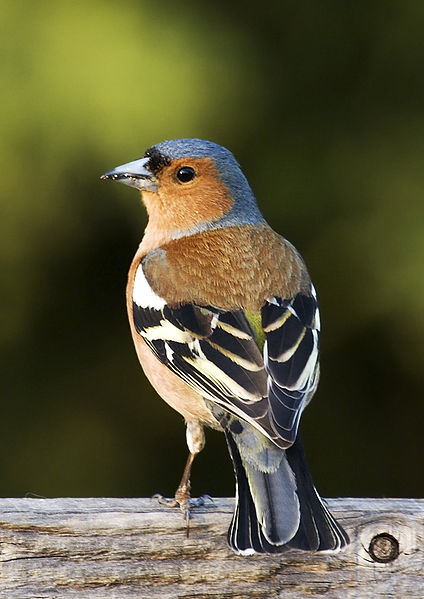
Fresh-firecoal chestnut-falls; finches' wings;
Landscape plotted and pieced - fold, fallow, and plough,
And all trades, their gear and tackle and trim.

All things counter, original, spare, strange;
Whatever is fickle, freckled (who knows how?)
With swift, slow, sweet, sour, adazzle, dim,
He fathers-forth whose beauty is past change:
Praise him.

File:Fringilla coelebs chaffinch male edit2.jpg
Chaffinch. Original photograph by MichaelMaggs, edited by  Arad

Word To Use Today: dapple. This word from the 1300s might be related to the Old Norse depill, which means spot.


Friday, 27 July 2018

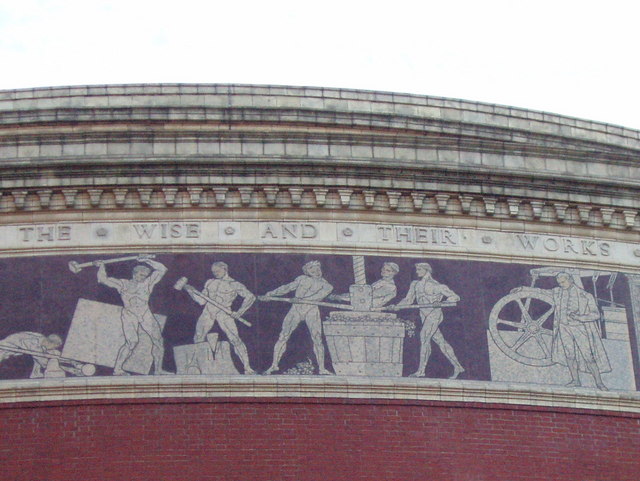
Word To Use Today: frieze.

All right, frieze may be one of the dullest words on earth, and, all right, it only means either a thick woollen fuzzy fabric or a painted border along the top bit of a wall, but the poor word has come down a long way, okay, and I think we should cherish it, out of pity if nothing else.

File:Frieze on the Royal Albert Hall - geograph.org.uk - 1430602.jpg
frieze on Royal Albert Hall, London. Photo by David Hawgood  CC BY-SA 2.0

Word To Use Today: frieze. The fabric word comes from the Old French frise and may be something to do with Frisian, but is more likely something to do with frizz, which is from the French friser, to curl. This fabric sort of frieze was occasionally fashionable, but mostly it was a fabric made for the poor, especially the poor of Ireland. (This form of the word hasn't really come down in the world because it had nowhere lower to go, poor thing.)

The painted-border word comes from the French frise, from the Latin Phrygium. The Phrygians (who lived from about 800BC - 600AD, first in the Southern Balkans and then in Turkey) were famous for their gold embroidery.


Thursday, 26 July 2018

Bigenders: a rant.

Last week's rant included the following words:


agender, bi-gender, cisgender, demigender, intergender, genderqueer, transgender and thirdgender 

and as I typed it I wondered why there was a hyphen in bi-gender, and not in the others? 

The whole naming-of-sexualities thing has got horribly complicated. Apparently trans-gender, with a hyphen, is offensive to some transgender people. Now, I don't want to offend anyone - well, not because of their (I daren't use his or her, here) sexuality, anyway - but I don't really understand why the hyphen should matter.

Bi-gender...

...and then I realised.

Well, it made me laugh.

Word To Use Today: bi-gender. Or, if you like, Big Ender. Bi-gender describes someone who describes themselves as bi-gender. Big enders (technically known as big endians in Jonathan Swift's Gulliver's Travels but often known as big enders) were inhabitants of the islands of Lilliput and Blefuscu who insisted on opening their boiled eggs at the large end. They remained the established authority (despite an assassination and a coup) on Lilliput, but in Blefuscu the little endian heresy took hold. 

The argument between the two sides was the cause of the war between the countries during Gulliver's visit.


Wednesday, 25 July 2018

Nuts and Bolts: -cide.

Although very nearly all words ending in -cide involve the death of someone (homicide, matricide, genocide) or something (avicide, acaricide, algicide) barmecide is, fortunately, nothing at all to do with getting rid of silly people.

Undecide is nothing to do with the casting away of lingerie, either.

Just so you know.

Word To Use Today: one ending with -cide. Avicide is the killing of birds, algicide the killing of algae, and acaricide the killing of mites and ticks. Homicide, matricide and genocide describes the killing of humans, mothers, and peoples respectively.

Barmecide entered the English language as a noun in the 1700s. It means imaginary and, therefore, disappointing. Barmakī was a prince in the Arabian Nights tales who gave a beggar a feast on beautiful but empty plates.