Yes, yes, I know that apostrophes have been used in varied ways over the centuries, but sometimes they do make a big difference.
Sir Robin Mountfield has died. He was a very senior civil servant, and also a grammatical stickler, who came up with my favourite example of how, occasionally, apostrophes really matter.
This example was a World War 2 headline, and it described a German army advance which had succeeded in surrounding part of the French army.
It said:
GERMANS' PUSH BOTTLES UP FRENCH REAR.
As Sir Robin pointed out so persuasively, without the apostrophe it could have had a rather different meaning.
Thing To Use Today: apostrophe. This word has come to us through Latin from the Greek word apostrephein, which, oddly, means to turn away.
Wednesday, 30 November 2011

Tuesday, 29 November 2011
Thing To Do Today. Or possibly not. Screeve.
Screeve is a lovely word, now sadly fallen into disuse.
It can mean to write quickly or continuously, which is surely something to be encouraged.
Or it can mean to ooze, which surely none of us ever aspires to do.
Or, if you're a horse, it means to fall with the legs apart while running on ice.
What a language, eh? How marvellous to have a word for that.
A screeve can be a piece of writing, a banknote, or a begging letter.
Whereas a screever is a pavement artist. This is a very fine thing to be as long as you work in something washable, like chalk.
So there we are: screeve. It's what I'd call a really generous word, too.
Thing To Do Today. Or possibly Not. Screeve. The ooze meaning comes from the Old French escrever, where it is used of wounds (lovely!). The reading-and-writing meaning comes from the Latin scrībēre, which means to write; and the falling-on-ice meaning comes from the Norwegian word skreva, to straddle.
Monday, 28 November 2011
Spot the frippet: fungi.
There are fungi wibbling all over the fields and woods of England at the moment - we have some lovely lilac blewits on our front lawn - but of course most of the fungi which exist around us (and inside us) are so small as to be invisible to the naked eye.
Pause to shudder with wonder, here, I think. Invisible fungi include yeasts, and antibiotics, as well as being part of what is rather spookily called gut flora.
Hey, and did you know that fungi are nearer to animals than plants?
That they are farmed, not only by people, but by ants and wasps and termites?
That fungi have cells made with chitin, which is the same stuff of which lobsters' skeletons are made?
That fungi are used to "stonewash" jeans?
That some fungi are utterly delicious?
Pause to shudder with wonder, here, I think. Invisible fungi include yeasts, and antibiotics, as well as being part of what is rather spookily called gut flora.
Hey, and did you know that fungi are nearer to animals than plants?
That they are farmed, not only by people, but by ants and wasps and termites?
That fungi have cells made with chitin, which is the same stuff of which lobsters' skeletons are made?
That fungi are used to "stonewash" jeans?
That some fungi are utterly delicious?
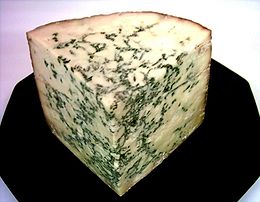
(This is a stilton cheese, and the fungus which inhabits it is called Penicillium roqueforti. Yes, it's used in Roquefort cheese, too.)
Spot the frippet: fungus. If you can't find a mushroom-type thing then any piece of bread or any alcoholic drink will contain fungi - and anyone with a beard or moustache is sporting face fungus.
The word is Latin for mushroom, and before that it came from the Greek word sphongos, which means sponge.
Which brings us back to the wibbly woods rather beautifully. doesn't it.
Sunday, 27 November 2011
Sunday Rest: Word Not To Use Today: ubiquitous,
The dreadful thing about some words is that they're too useful. For instance, ubiquitous. It's a horrible, oily, orange-lamp-lights-on-wet-streets word, but it gets everywhere.
I suppose one could use omnipresent, instead, but omnipresent has a great lumbering hump at the beginning and a spit in the middle, and I think might be slightly uglier even then ubiquitous.
Basically, the world would be a better place if we avoided both of them. It's quite possible to do so. After all, I've written rather a lot of novels and I don't think I've used either ubiquitous or omnipresent in any of them.
Actually, I've just checked, and I haven't even used them in Goldkeeper - and that's all about God.
So I'm calling for a unilateral ban.
Okay?
Thank you very much. I appreciate it, I really do.
Word Not To Use Today: ubiquitous. What have the Romans ever done for us? Well, they've given us ubiquitous. It comes from the Latin word ubīque, which means everywhere.
Saturday, 26 November 2011
Saturday Rave: Rapunzel.
Ooh, there's a lot of misery in this story, and the plot gapes with holes at every turn.
But then putting characters somewhere where they have great trouble getting in or out will always cause trouble.
In some ways it's a shame the arch-plotter Agatha Christie wasn't around when the story was first being put together - though, I don't know, the whole thing has such an air of danger and strangeness and mystery that the holes serve to give us glimpses of mysteries and horrors yet more enticing than those before us.
Poor Rapunzel, anyway. Not only does she suffer horribly, but she's called after a vegetable - and not even a nice vegetable, but something, a rampion, which I understand has a root which tastes like a not-very-nice parsnip, and leaves which taste like not-very-nice spinach.
Oh, but I do wish the story was Scandivavian instead of German (or possibly French, or Persian, or Roman), because then she'd be a Swede, as well.*
Word To Use Today: rampion. Hm, the opportunities for chatting about obselete vegetables are, I must admit, few. It's a lovely word, though, and may be of use in such phrases as I'd rather eat a mouldy rampion. Or you could ask for rampions in your local supermarket and get a reputation for being...well, utterly bonkers.
The word rampion comes from the French raiponce and before that from the Old Italian raponzo, from the Latin rāpa, which means turnip.
*Sorry, this joke doesn't work in America - a swede is what I believe Americans call a rutabaga.
Friday, 25 November 2011
Word To Sing Today: cockle.
Mary Mary quite contrary
How does your garden grow?
With silver bells and cockle shells
And pretty maids all in a row.
But what the cockles mean in this nursery rhyme - if anything - is anyone's guess. If the rhyme is about being a Roman Catholic, then they're perhaps a symbol of pilgrimage; if it's about Mary Queen of Scots, then they might be a snide joke about her husband's not being faithful; if it's about the English queen Mary Tudor then they might even be a sort of instrument of torture - which is a horrible use of a lovely word.
Anyway, we're lucky enough to have another cockle song to sing, too, if we feel like it: there's an Irish one about Molly Malone, who:
wheeled her wheelbarrow
Through streets broad and narrow
Crying cockles and mussles alive alive-oh.
Now, this song seems to be about - well, a young lady who sold shellfish.
And thank heavens for that.
Now, cockles: they're not stupid, you know. They spend their lives lying about on sheltered sandy beaches, which surely proves it.
They have a sucking-in water hole, a blowing-out water hole, and a foot hole (they can jump about if they want to); and as the sea water in which they live is a sort of thin soup of their food, plankton, they never have to go shopping.
In England our ancient (1215) Bill of Rights, Magna Carta, gives everyone the right to gather eight pounds of cockles without a licence, hurray!
How nice to think of all those ancient barons worrying about the common people's need for shellfish. Why, it's enough to warm the cockles of your heart, that is.
What? Oh. Well, cockles are heart-shaped, which is possibly something to do with it.
Word To Sing Today: cockle. The word for the shellfish sort of cockle comes from the Old French word coquille, which means shell, and before that from the Greek word konkhulion, which means little mussel.
As for cockles of the heart, well the scientific name for a cockle begins Cardium, which is the Latin for heart. Little heart is coculum.
Or perhaps it's come from the scientific name for part of the heart, the ventricles, which is cochlea cardis.
Thursday, 24 November 2011
Your word is your bond: a rant.
There are seventeen countries which use the sort of money called the Euro. Some of them are quite hard up, and these countries think it would be a jolly good idea if the others shared their money around a bit.
For some reason, however, the countries with plenty of money don't seem to agree.
Faced with this difficulty, I was charmed to see that Olli Rehn (whose job it is to keep the Euro countries friendly with each other) has come up with a cunning plan.
One way money could be shared around is by making things called Euro bonds, which, as you can tell from the sound of them, are a way of tying all the Euro-using countries together so that all their money is in the same pot.
And what is Mr Rehn's cunning plan? Well, he's suddenly started calling them stability bonds instead of Euro bonds.
Now, of course everyone wants stability: and all of a sudden instead of being ropes to tie people to their needy neighbours, the bonds have become guy ropes to prevent the whole caboosh blowing away in a storm.
Cunning, eh?
And, given the immense power words have over the human brain (which is the same sort of power that air has over the human lungs) it might even work, too.
All because of one small word.
Cunning. Devilish cunning.
Word To Use Today: stability. This word comes from the French word estable, from the Latin word stabilis, which means steady, from stāre, to stand.
Subscribe to:
Posts (Atom)