This blog is for everyone who uses words.

The ordinary-sized words are for everyone, but the big ones are especially for children.


Monday, 14 January 2013

Spot the frippet: tangent.

This is a lovely juicy word:

tangent.

Can't you just taste the citrus?

No?

Oh...

...well, perhaps I'm getting some sort of mental short-circuit from tangerine, then...

Anyway.

You know about tangents, of course - though, actually, it's more off course, because if someone's gone off at a tangent then they've veered widly away from the direction upon which they appeared to be set.

Tangents are also mathematical things you get when studying triangles and circles:


The thing to remember is that tangents are to do with touching. The circles above are tangent circles because the edges touch at just one point. You might spot the top sort of tangent circles in a cartoon's eye, or you could make some with coins or carrot slices or counters.

A tangent can also be a straight line which touches a curve. A wheel sitting on a road is an easy example.

A tangent space is the same sort of thing, but in 3D. Think of a mortar board:

File:Mortarboard (PSF).png

the flat top is a tangent space because it touches the curved hat-bit at one point.

If you're talking about triangles (and you never know) then tangents allow people to work out stuff about the sizes of the triangles'  sides and angles. But you can't actually see this sort of tangent, so we needn't bother with it. Phew.

Lastly, a tangent is part of the inside of a clavichord. A clavichord is a sort of old piano-type thing:

woman playing a clavichord

and the tangents are small pieces of metal that jump up and hit the strings to produce the sound.

There we are. Is there anything else? Ah yes.

Going off at a tangent is one of the great joys of life.

And, come to think about it, it's what The Word Den is largely about.

Spot the frippet: tangent. This word comes from the Latin phrase līnea tangēns, whihc means touching line.


Sunday, 13 January 2013

Sunday Rest: Word Not To Use Today: stellify.

I came across this word only the other day and, ooh, I do loathe it. I loathe it passionately. I can feel a warm flush of revulsion running under my skin as I type.

No, there's no way I'm using this one.

It has the most gorgeously beautiful meaning: to be made into a star.

Could anything be more full of beauty and wonder? More mysterious, more sparkling, more numinous?

And what word we have for it?

********!

And when are we going to use it?

NEVER!

Phew. That's better out than in. What a relief. Thank you. Thank you really very much...

Word Not To Use Today Or Indeed Ever If I Have Anything To Do With It: ********. This word comes from the lovely Latin word stella, which means star.

Saturday, 12 January 2013

Saturday Rave: The Warden by Anthony Trollope.

The Warden was Anthony Trollope's breakthrough novel.

It's about a clergyman - the sweetest, most innocent old man who ever breathed - and his partly justified persecution by a vicious press.

There's also a love story.

The Warden is the first of The Barchester Chronicles (though the books which follow in the series are much longer and more complex than The Warden). After several thousand pages about the people of Barset, a few of the characters sort of branch out sideways and start off another series of books called The Pallisers.

If you have time to read thousands and thousands of pages about life in the 1860s (which is so very much like life in the 2010s) I would recommend them all.


septimus-harding


septimus-harding
septimus-harding
Word To Use Today: warden. This word arrived in English in the 1200s. It comes from the Old Northern French wardein, from warder, which means to guard.

Friday, 11 January 2013

Word To Use Today: dastard.

Is there any word in the world more fun to use than this one?

Dastard!

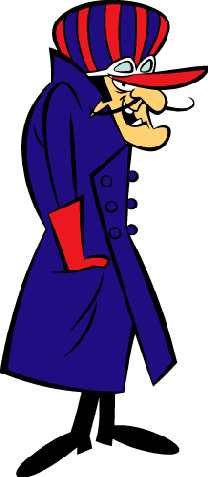
File:Dickdastardly.gif

That picture is of course of the splendid Dick Dastardly, of Wacky Races fame. And when I talk of fame, I'm talking about a man so famous that he's changed the meaning of the word dastard.

To me, as to millions (billions, perhaps) a dastard is a deep-dyed villain.

But to the dictionary a dastard is a contemptible sneaking coward. (That's what it says: a contemptible sneaking coward. Presumably that's as opposed to an admirable coward, which of course we usually term a statesman.)

Dastard is called old-fashioned by the lexicographers, but it's too much fun to leave unused and I think we should take it out and give it a jolly good airing.

After all, if the person you call a dastard is a dastard in the old dictionary sense then you'll probably get away with it.

Word To Use Today: dastard. This word was first used in England in the 1400s, when it meant someone stupid. It probably comes from the old Norse word dæstr, which means exhausted or out of breath.

Thursday, 10 January 2013

The bouncy bridge: a rant.

There's been a bit of a row about the word data.

Well, there's often a bit of a row about the word data.

Is it singular or plural?

When it was Latin it was definitely plural, but now it's English it's...well, it's either singular or plural, really. If you take really to mean what's being used and understood out there in the world.

Used and understood. That's what matters, isn't it?

One of the things language does is to make bridges between minds (it makes me shiver with wonder just thinking about it).

This means that whatever meaning a word has, it needs to be the same in at least two minds.

If the word is spoken, then it's likely to be not many more than two minds, and in this case it's easy to come to an agreement about the meaning of a word. In the wonderful but ancient TV drama Colditz, for example, the word HONEYMOON meant something extraordinarily awful to one man and his wife, but of course that doesn't mean that anyone else can use the word honeymoon to mean something extraordinarily awful if they wish to be understood.

The more people there are who need to cross the bridge, the more stable it has to be: but there's no point in trying to argue that words mustn't alter; and no point either in trying to argue that words can change all the time in all directions.

The important thing is that the bridge doesn't fall to pieces when someone is half way across.

Word To Use Today: data. This word is the Latin plural of the word datum, which means something given.

Wednesday, 9 January 2013

Nuts and Bolts: mondegreen.

Hurray for the Bonny Earl of Murray, who gave us the word mondegreen.

No, I agree it's not a very nice word, but it's a pleasing and useful one to have around, all the same.

And what's the Bonny Earl of Murray got to do with it?

Well, it's all to do with this ballad:

Ye Highlands and ye Lowlands,
Oh, where hae ye been?
They hae slain the Earl O' Moray,
And Lady Mondegreen.

...except that it isn't actually Lady Mondegreen who got it in the neck at all: the Earl of Murray was slain alone. What happened was that they slew him, and then they laid him on the green.

Geddit?

I think that Lady Mondegreen is quite possibly an improvement.

Childhood is full of mondegreens. There's the famous hymn about Gladly, my cross-eyed bear, for instance (or, as the grown ups imagine, Gladly my cross I'd bear), and I personally spent quite a lot of time wondering where the three kings' home town of Orientar was. I even looked it up in the atlas.

Then there was the hit song Oh a tree in motion. It did seem a bit strange, but didn't get that one sorted out until...oooh...probably two or three years ago.

Ah well. Isn't wondering what on earth's going on what life is all about?

And if it isn't, well then, it should be.

Thing To Enjoy Today: a mondegreen. Everyone has their own examples. The American writer Sylvia Wright coined the term in her article "The Death of Lady Mondegreen," published in Harper's Magazine in 1954.

Tuesday, 8 January 2013

Thing To Do Today: shiver.

I'm wrapped in furry stuff, but I'm still shivering.

No, I know that it's not really that cold here in England, especially when you consider that the district of Oymyakon in Russia has a record high January temperature of -14C. But even 7C is quite cold enough for me.

Of course if you're in Oodnadatta in South Australia, which registered a temperature of  50.7 C on the 2nd January 1960, then you won't be shivering with cold.

But there are other reasons to shiver.

Shiver with awe at a mountain dawn, or an infant, or the exquisite shininess and grace of a single blade of grass.

Shiver with fear at...well, footsteps coming up from behind can be pretty terrifying. And so can cats jumping onto your bed in the middle of the night, especially when you haven't got a cat. And as for kebab vans...

You could sail close enough to the wind to make your sails shiver.

You could take a piece of ice or glass and shiver it into a thousand pieces.

Or, best of all, you could shiver with delight:

 
If all else fails, get someone to say once upon a time to you. A shiver of anticipation then is almost guaranteed.
 
Thing To Do Today: shiver. This word may be a variation of chevelen, which means to chatter (as in teeth), from the Old English ceafl, which means jowl.