What's a mactard?
Some sort of mediaeval jerkin? A particularly complicated design of roof?
A spike for fending off marauding barons?
Well, no: the fact is that although mactard does have a mediaeval ring to it, it's actually a rather new word. It's also rather a nasty one. A mactard is someone who spends a lot of time telling the world that Apple computers are better than any other sort of computers, and that those people who use Apple systems are cleverer than any other sort of person.
The word mactard is used by someone who feels deeply humiliated by this opinion.
I expect there are arguments for and against Apple technology (I myself have never managed to get any Apply device to obey me) but there's surely no need to be unkind.
Well, not unless you're facing a marauding baron there's not, anyway.
Word Not To Use Today: mactard. The mac bit of this word is from the Apple brand name Macintosh, and the tard bit comes from retard, from the Old French retarder, from the Latin tardus, slow.
Sunday, 13 March 2016

Saturday, 12 March 2016
Saturday Rave: Richard Steele.

That's Sir Richard Steele. It's his birthday today: he was born on March 12th 1672.
Steele is most famous for founding and writing The Spectator magazine with Joseph Addison, but he suffers from being the second-named in that partnership. Whether this happened because of euphony, the alphabet, character, age (Addison was a few months younger) or investment I do not know.
Apart from writing for The Spectator, and writing most of The Tatler magazine, Steele was a soldier, a politician, and wrote several plays. A couple of them were even hits. Best of all, his wit and wisdom illuminate our own times quite as much as his:
'Fire and swords are slow engines of destruction compared to the tongue of the Gossip'
could have been minted for the Age of Twitter; and:
'Whenever you commend, add a compelling reason for doing so; it is this which distinguishes the approbation of the man of sense from the flattery of sycophants and the admiration of fools'
could usefully be printed at the head of every REVIEW box on Amazon or Goodreads.
Steele is admired for his wit:
'It is to be noted that when any part of this paper appears dull there is design in it'
and satirical eye:
'good breeding is an expedient to make fools and wise men equal.'
Richard Steele got into trouble for his opinions (he was expelled from the House of Commons, and he quarrelled finally with his old school-friend Addison over politics) and in the end, having lived a busy and rather noisy life, he retired to Wales to a quiet old age.
Luckily he left his words behind, because we need him still.
Word To Use Today: satire. This word comes from the Latin satira, a mixture, from satis, enough.
PS: 'A woman seldom writes her mind but in her postscripts.'
Um...well, some of his words, anyway.
Friday, 11 March 2016
Word To Use Today: parapet..
A nice crisp word, is parapet, though the thing itself tends to be rather worrying.

Fresco by Paulo Veronese. Figures behind a parapet, about 1560.
A parapet is a wall that edges a drop, though it's usually not high enough to stop you falling over it.
Parapet's military sense is rather different, because there it is a mound of sandbags, a bank, or a rampart in front of a trench. This sort of parapet is also sometimes called a breastwork.

This is quite interesting if you know the word parapet's derivation.
Word To Use Today: parapet. This word comes from the Italian parapetto, literally chest-high wall, from the Latin pectus, breast.
Fresco by Paulo Veronese. Figures behind a parapet, about 1560.
A parapet is a wall that edges a drop, though it's usually not high enough to stop you falling over it.
Parapet's military sense is rather different, because there it is a mound of sandbags, a bank, or a rampart in front of a trench. This sort of parapet is also sometimes called a breastwork.
This is quite interesting if you know the word parapet's derivation.
Word To Use Today: parapet. This word comes from the Italian parapetto, literally chest-high wall, from the Latin pectus, breast.
Thursday, 10 March 2016
All in all: a rant.
I'm not claiming that all actually does mean all. When someone says I was coughing all night then no one is expect to believe that he or she was indeed coughing all night: in this case the use of the word all is merely intensifying a tacit request to acknowledge the cougher's bravery in being able to function at all.
When a decent and honest publisher says it wants all rights in a book, the actual contract will then go on to say though not copyright or moral rights.
When a much-respected pianist, conductor and composer says you're playing all the wrong notes! It's unexpected for someone to reply:*
But even so, those catalogues which insist on labelling saucepans:
suitable for ALL hobs (except induction)
are being really extremely perverse and annoying in their use of capital letters.
Word to Use in Lower Case Letters Today: all. This word has been around for ages. The Old English form was eall.
*If that video has been blocked by the BBC, the reply to André Previn's critique is: I'm playing all the right notes - but not necessarily in the right order.
Wednesday, 9 March 2016
Nuts and Bolts: how many Danish?
How many Danish?

Photo by Smuconlaw
Well, unfortunately, in this picture there are more than forty nine Danish pastries, and after that...well, after more than forty nine Danish pastries you probably wouldn't care much how Danish numbers work, but the fact is that Danish counting cunningly combines two systems, one based on the number twenty (French does something rather similar) and one on some old expressions for two and a half, three and a half, etc.
The number sixty is straightforward. That's tres(indstyve), or third*-times-of-twenty. (You don't usually bother to say the bit in brackets.) It's a bit long, perhaps. but sixty is three times twenty, so fair enough.
But what about the number fifty? That's halvtres(indstyve) or half-third*-times of twenty.
The trouble is, as far as I can do the arithmetic, there is no way fifty is half third* times twenty.
Pleasingly, the numbers seventy and ninety behave in the same way as fifty, and make no more sense.
Now, I've said that Danes don't usually use the bits of the numbers I've put in brackets, but if you're saying fiftieth or sixtieth, for instance, then shortening numbers is most definitely not done. Fiftieth is halvtredsindstyvende, which is so awkward that a lot of the time Danish people are beginning to say nummer halvtreds instead.
Norway and Sweden have number systems based on tens, but trying to introduce a similar system into Danish has met with no success except in inter-Scandinavian communication and on money documents, when one may use femti, seksti, syvti, otti and niti.
Is the Danish system unwieldy and illogical? Yes. Should the Danish people abandon it?
No, of course not, They should cherish it and glory in it.
And I'm delighted they are.
Word To Use Today: Danish.The first mention of the Danes was in the 700s, when they were a tribe inhabiting Jutland.
*That's third as in first, second, third, not as in one divided by three.
Gosh, English is pretty weird, too, isn't it.
Tuesday, 8 March 2016
Thing To Do Today: coax.

An odd word, coax.
In fact, the more I look at it the less it looks like a genuine English word, even though it's been around since the 1500s, and in this spelling since the early 1700s.
We spend a lot of time coaxing things: ketchup out of bottles, rabbits out of the chimney (well, okay, that was possibly just me), hair into or out of curls, vegetables into children's mouths, vegetables into adults' mouths.
The ketchup example is, I think, particularly interesting. Obviously I know little of your spiritual beliefs, but as far as I know no one among all the billions of humans on the planet has ever imagined ketchup to have the gift of sentience; and yet still we coax it, even talk to it come on, then, just a small dollop on the chips. Thank you! just as we coax ovens to light (my own oven needs a very gentle hand), and cars and lawn mower engines to purr into life.
Good luck with today's coaxing, whether it's getting a toddler to put on his coat, the dog to leave the lamp post, the husband to put out the bin, or the jeans to fit over the hips.
Coaxing things is a sign of hope, after all; just as kicking them is really a sign of despair.
Thing To Do Today: coax. This word comes from the noun cokes, which meant a fool.
Monday, 7 March 2016
Spot the Frippet: cobbler.
In the olden days cobblers lived in ancient cottages and relied on elves to save them from bankruptcy.
Now most cobblers are hidden away in factories, and the elves have been mostly replaced by angels.
People - real people - are still around to mend shoes, though, if not to make them, and the higher your heels the more often you will need their rubber tips renewing.

Photo by THOR
But if you're addicted to flats then there are other cobblers around. A cobbler can be a sweetened iced drink, usually made from wine and fruit, or it can be a pudding, in which case it consists of hot fruit covered by a scone dough (that's a biscuit dough if you're in America).
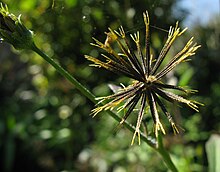
Cobbler's wax is a sort of resin used for waxing thread, and cobbler's pegs is an Australian weed, Bidens pilosa:
Commonest of all, though, are a load of cobblers, which is a slightly rude expression for a load of rubbish.
You'll find that sort of cobblers absolutely everywhere.
Spot the Frippet: cobbler. No one knows where the word for shoe maker comes from, but it's been a surname since the 1200s. The drink may be a shortened form of cobbler's punch. Cobblers meaning rubbish is rhyming slang, and the original expression was cobbler's awls.
Now most cobblers are hidden away in factories, and the elves have been mostly replaced by angels.
People - real people - are still around to mend shoes, though, if not to make them, and the higher your heels the more often you will need their rubber tips renewing.
Photo by THOR
But if you're addicted to flats then there are other cobblers around. A cobbler can be a sweetened iced drink, usually made from wine and fruit, or it can be a pudding, in which case it consists of hot fruit covered by a scone dough (that's a biscuit dough if you're in America).
Cobbler's wax is a sort of resin used for waxing thread, and cobbler's pegs is an Australian weed, Bidens pilosa:
Commonest of all, though, are a load of cobblers, which is a slightly rude expression for a load of rubbish.
You'll find that sort of cobblers absolutely everywhere.
Spot the Frippet: cobbler. No one knows where the word for shoe maker comes from, but it's been a surname since the 1200s. The drink may be a shortened form of cobbler's punch. Cobblers meaning rubbish is rhyming slang, and the original expression was cobbler's awls.
Subscribe to:
Posts (Atom)