If I have a television here in Britain I'm forced by law to pay £145.50 a year to fund the British Broadcasting Corporation's output.
And what does the BBC produce with this sizable chunk of my hard-earned cash?
Well, there's a programme they keep advertising on BBC Radio 4 called Cross Incontinence.
Call that Public Service Broadcasting? I should coco. Honestly, just what do they think...
...what?
Really?
Are you sure?
Oh.
Well, okay, I suppose Crossing Continents might be all right - but just don't get me started on some of the rest!
Word To Use Today: continence. This word comes from the Latin continēre, from tenēre, to hold.
Thursday, 14 April 2016

Wednesday, 13 April 2016
Nuts and Bolts: putting things in their places.
Is your house called Rose Cottage? Or Seaview? Or Grantley Place?
It probably isn't. No, the chances are that your house has a number instead of a name. It's less picturesque, but it does help people to predict where No 53 might be situated (sadly, in my road, the answer is opposite No 24, but hey....)
You find this basic system doing all sorts of useful work all over the world. It helps, for instance, that the year 2016 comes immediately after the year 2015.
When the French were reorganising their calendar after their first revolution, they called the days of their ten-day week primidi, duodi, tridi...first day, second day, third day...all the way up to décadi, the tenth day. This is clearly much more sensible than calling the days of the week after random gods or astral bodies - though, it must be admitted, not as much fun.
But what if you're creating a whole new land, pretty-much from scratch? Well, that was more or less what was happening when the Grand Trunk Pacific Railway was constructed in the north of Canada. The route went through mostly uninhabited and unnamed areas, and so the decision was taken to name the stations alphabetically as they built the line.
There were ninety three stations in all, so they got through the alphabet several times.
Many of these stations, and the towns that grew up beside them, still bear these alphabetical names. Edmonton is the largest, but Watrous is a substantial town, too. Tate, however, was never much more than a sign.
It's not quite such a logical system as calling the stations One, Two, Three, but I'd much rather live in Bloom, or Clavet, or Dunn than Sixty Three.
Wouldn't you?
Thing To Do Today: think of a really good name for your house. I've always rather wanted to call mine Gormenghast.
Tuesday, 12 April 2016
Thing To Do Today. Or Possibly Not: closet oneself.
These days we are forever leaping out of the closet with some news or other.
I'm gay! I don't shave under my arms! I eat meat! I don't like kittens!
Oh, okay, not that last one. No one is that brave.
Anyway, closet. The first closet I knew about was a water closet, as in WC, and so when in eighteenth century books heroines went to their closets to weep or pray it did seem rather odd behaviour (we don't generally call our cupboards and wardrobes closets in England. Not that going and sitting in a wardrobe would have been much less peculiar).
But, as gradually became clear to me, these heroines' closets were in fact small private rooms. Presumably it's this sort of closet we leave nowadays to make our confessions - and also the sort of closet we closet ourselves in when we want to have a private chat.
But what about a closet strategist? Is that some sort of an interior designer?
Well, no, not usually, but what one is depends on where he is. In Britain a closet strategist is a secret strategist; in America his strategy isn't secret, but speculative.
It's the sort of baffling quirk of language that keeps the relationship between Britain and America so very very special.
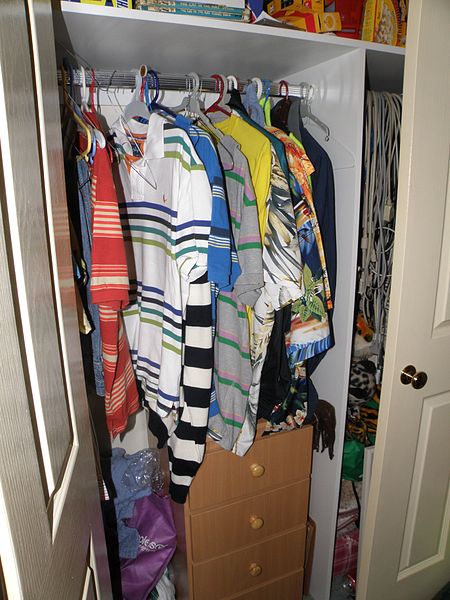
Photo of an Australian closet by Matthew Paul Argall
Thing To Do Today, Or Possibly Not: closet oneself. This word comes from the Old French, from clos, enclosure. It's basically the same word as close.
I'm gay! I don't shave under my arms! I eat meat! I don't like kittens!
Oh, okay, not that last one. No one is that brave.
Anyway, closet. The first closet I knew about was a water closet, as in WC, and so when in eighteenth century books heroines went to their closets to weep or pray it did seem rather odd behaviour (we don't generally call our cupboards and wardrobes closets in England. Not that going and sitting in a wardrobe would have been much less peculiar).
But, as gradually became clear to me, these heroines' closets were in fact small private rooms. Presumably it's this sort of closet we leave nowadays to make our confessions - and also the sort of closet we closet ourselves in when we want to have a private chat.
But what about a closet strategist? Is that some sort of an interior designer?
Well, no, not usually, but what one is depends on where he is. In Britain a closet strategist is a secret strategist; in America his strategy isn't secret, but speculative.
It's the sort of baffling quirk of language that keeps the relationship between Britain and America so very very special.
Photo of an Australian closet by Matthew Paul Argall
Thing To Do Today, Or Possibly Not: closet oneself. This word comes from the Old French, from clos, enclosure. It's basically the same word as close.
Monday, 11 April 2016
Spot the Frippet: brow.
Most of us have eyebrows, though some of us make do with just the one long wiggly one (the King James Bible is strongly pro-monobrow. Deuteronomy 14: 1 says ye shall not...make any baldness between your eyes).
Of course one can't talk of monobrows (or unibrows, as they are sometimes known) without mentioning Frida Kahlo, so here she is:

Having said all that, while half the world is blackening its brows to make them more obvious, the rest of us are plucking them for fear of attracting the attention of birds searching for nesting material. Still, even if you live in a society where eyebrows are completely plucked, or perhaps where faces are veiled and mirrors illegal, then unless you live in an endless plain then you're all right because of course hills have brows, too, and so do the tops of mine shafts and pitheads; and someone who's browbeaten, that is frightened by threats or daunted by unkindness, will probably have a troubled brow, which extends meaning of brow to the whole forehead.
The nice thing is that the brow-of-a-hill word is the same word as the eyebrow sort of a brow.
It makes me regard the trees that fringe my hilly horizon in an entirely new light.
Spot the Frippet: brow. This word comes from the Old English brū, is related to Old Norse and Lithuanian words, and goes right back to the Sanskrit bhrūs.
Of course one can't talk of monobrows (or unibrows, as they are sometimes known) without mentioning Frida Kahlo, so here she is:
Having said all that, while half the world is blackening its brows to make them more obvious, the rest of us are plucking them for fear of attracting the attention of birds searching for nesting material. Still, even if you live in a society where eyebrows are completely plucked, or perhaps where faces are veiled and mirrors illegal, then unless you live in an endless plain then you're all right because of course hills have brows, too, and so do the tops of mine shafts and pitheads; and someone who's browbeaten, that is frightened by threats or daunted by unkindness, will probably have a troubled brow, which extends meaning of brow to the whole forehead.
The nice thing is that the brow-of-a-hill word is the same word as the eyebrow sort of a brow.
It makes me regard the trees that fringe my hilly horizon in an entirely new light.
Spot the Frippet: brow. This word comes from the Old English brū, is related to Old Norse and Lithuanian words, and goes right back to the Sanskrit bhrūs.
Sunday, 10 April 2016
Sunday Rest: pudibond. Word Not To Use Today.
There are several good reasons not to use the word pudibond, the first of which is that it seems to be a misspelling. I came across the foul thing in the introduction to The Stuffed Owl, an anthology of bad verse compiled by Wyndham Lewis and Charles Lee, but pudibond, though good French, seems to be bad English.
In English it's pudibund. Mind you, that might be even worse.
Reasons not to use it:
1. No one will have a clue what you're going on about.
2. It will make you look a snob...
3. ...and an idiot.
4. It's one of the very ugliest words in the English language.
5. Its spelling is a matter of some doubt.
6. It means two similar but opposed things, which will only lead to confusion and distress.
So what does it mean? Well, it can either mean a subject of shame, or it can mean modest, bashful or prudish.
As this collection of synonyms shows, pudibond (or bund) can be safely ignored for all eternity without being the slightest bit missed.
Word Not To Use Today: pudibond/bund. This word comes from the Latin pudēre, to make or be ashamed.
There's a word pudibundity, but that's so silly it's almost endearing.
Saturday, 9 April 2016
Saturday Rave: Edouard-Leon Scott de Martinville's Au Clair de la Lune
Today is the 156th anniversary of something wonderful.
On April 9th 1860 Édouard-Léon Scott de Martinville sang the beginning of the French traditional song Au Clair de la Lune.
Was he a brilliant singer who transformed a simple folk song into an imperishable emotional journey?
Well, not on the evidence we have, no. He seems to have been a pretty awful singer, and the probable proof of this is in his choice of song, which stays pretty much as close to a single pitch as it can get while still calling itself a tune, as generations of beginner musicians can with gratitude attest.
HERE Édouard-Léon Scott de Martinville is (at least, we assume it's he) singing. This isn't actually the April 9th version, as a matter of fact (that's HERE) but one sung a week later.
Yes, it is painful: so why is it so marvellous and important?
Because this recording is the very first ever of a human voice saying intelligible words.
Even more magically, de Martinville had no idea at the time that his recording would ever be played back. What he was trying to do was to make a picture of the human voice. He constructed his recording device, which he called a phonautograph:

(here it is)
based on the mechanics of the human ear. Here, below, is a bit of a phonautograph recording, which was traced by a vibrating pig bristle onto a piece of paper covered in soot from an oil lamp.

That was more or less that until 2007, when David Giovanni, Patrick Feaster, Meagan Hennessey and Richard Martin formed First Sounds, a project to bring to the world the first recordings of the human voice. And then, by a leap of combined logic, intelligence, engineering and faith, they managed to turn these sooty lines back into something we can hear.
What, short of a unicorn in the garden, could be much more magical than that?
Word To Use Today: phonautograph. I suppose the auto bit of this word does tend to suggest the recorded voice is de Martinville's own, doesn't it, because auto- comes from the Greek autos, which means self.
On April 9th 1860 Édouard-Léon Scott de Martinville sang the beginning of the French traditional song Au Clair de la Lune.
Was he a brilliant singer who transformed a simple folk song into an imperishable emotional journey?
Well, not on the evidence we have, no. He seems to have been a pretty awful singer, and the probable proof of this is in his choice of song, which stays pretty much as close to a single pitch as it can get while still calling itself a tune, as generations of beginner musicians can with gratitude attest.
HERE Édouard-Léon Scott de Martinville is (at least, we assume it's he) singing. This isn't actually the April 9th version, as a matter of fact (that's HERE) but one sung a week later.
Yes, it is painful: so why is it so marvellous and important?
Because this recording is the very first ever of a human voice saying intelligible words.
Even more magically, de Martinville had no idea at the time that his recording would ever be played back. What he was trying to do was to make a picture of the human voice. He constructed his recording device, which he called a phonautograph:
(here it is)
based on the mechanics of the human ear. Here, below, is a bit of a phonautograph recording, which was traced by a vibrating pig bristle onto a piece of paper covered in soot from an oil lamp.
That was more or less that until 2007, when David Giovanni, Patrick Feaster, Meagan Hennessey and Richard Martin formed First Sounds, a project to bring to the world the first recordings of the human voice. And then, by a leap of combined logic, intelligence, engineering and faith, they managed to turn these sooty lines back into something we can hear.
What, short of a unicorn in the garden, could be much more magical than that?
Word To Use Today: phonautograph. I suppose the auto bit of this word does tend to suggest the recorded voice is de Martinville's own, doesn't it, because auto- comes from the Greek autos, which means self.
Friday, 8 April 2016
Word To Use Today: teetotal.
What put the tee in teetotal?
I always thought that if you were abstaining from alcohol, as teetotallers do, then obviously you'd need plenty of cups of tea to keep you going. And the reason it wasn't teatotal was...well, perhaps the tee in teetotal was one of those fancy fashionable spellings designed for marketing purposes, in the way that something called Eezikleen is trying to persuade us that scrubbing our skirting boards is fashionable and fun.

The Drunkard's Progress, a piece of teetotal propaganda by Nathaniel Currier
I was quite wrong about this - though to be fair no one is sure whence the tee in teetotal sprang.
Was it because Richard Turner had a stammer, and in a speech at the Preston Temperance Society in 1833 declared 'I'll be reet down out-and-out t-t-total for ever and ever.' (The total standing for totally abstaining from alcohol.)
That story is set in England, but a slightly modified version of the story 'partial abstinence from intoxicating liquors would not do, they must insist on tee-tee-tee total abstinence' was current in Charleston, in America, by 1836.
It's a good story, and well worth carrying across the ocean, but I wonder if it's just too good to be true. Richard Turner would have been among sober fellow-enthusiasts at that meeting, and they surely would have been unlikely to form the name for their way of life from an unfortunate mispronunciation.
But then, perhaps there were trouble-makers present.
There are other theories about the origin of the tee. It might have come from the 1820s practice of writing a T after one's name to signify a pledge of abstinence (it was an easy sign to write even for the illiterate). Similar claims as to the significance of the letter T have been made for the files of the American temperance preacher Lyman Beecher.
What's worth remembering is that T-total had a life outside abstinence: in the 1830s T-total meant absolutely total, and not just with reference to drink. A cellar might be in T-total darkness, for instance, or a horse a T-total thoroughbred. So Richard Turner's T-total might have been an early example of this usage.
Of all the possibilities, this one rings most true to me.
Word To Use Today: teetotal. Total comes from the Latin tōtus, which means all.
I always thought that if you were abstaining from alcohol, as teetotallers do, then obviously you'd need plenty of cups of tea to keep you going. And the reason it wasn't teatotal was...well, perhaps the tee in teetotal was one of those fancy fashionable spellings designed for marketing purposes, in the way that something called Eezikleen is trying to persuade us that scrubbing our skirting boards is fashionable and fun.
The Drunkard's Progress, a piece of teetotal propaganda by Nathaniel Currier
I was quite wrong about this - though to be fair no one is sure whence the tee in teetotal sprang.
Was it because Richard Turner had a stammer, and in a speech at the Preston Temperance Society in 1833 declared 'I'll be reet down out-and-out t-t-total for ever and ever.' (The total standing for totally abstaining from alcohol.)
That story is set in England, but a slightly modified version of the story 'partial abstinence from intoxicating liquors would not do, they must insist on tee-tee-tee total abstinence' was current in Charleston, in America, by 1836.
It's a good story, and well worth carrying across the ocean, but I wonder if it's just too good to be true. Richard Turner would have been among sober fellow-enthusiasts at that meeting, and they surely would have been unlikely to form the name for their way of life from an unfortunate mispronunciation.
But then, perhaps there were trouble-makers present.
There are other theories about the origin of the tee. It might have come from the 1820s practice of writing a T after one's name to signify a pledge of abstinence (it was an easy sign to write even for the illiterate). Similar claims as to the significance of the letter T have been made for the files of the American temperance preacher Lyman Beecher.
What's worth remembering is that T-total had a life outside abstinence: in the 1830s T-total meant absolutely total, and not just with reference to drink. A cellar might be in T-total darkness, for instance, or a horse a T-total thoroughbred. So Richard Turner's T-total might have been an early example of this usage.
Of all the possibilities, this one rings most true to me.
Word To Use Today: teetotal. Total comes from the Latin tōtus, which means all.
Subscribe to:
Posts (Atom)