This blog is for everyone who uses words.

The ordinary-sized words are for everyone, but the big ones are especially for children.


Wednesday, 7 September 2016

Nuts and Bolts: The age of fairy tales

How old are stories? As old as speech, perhaps:

There was once a boy who wouldn't keep quiet when his family were hunting and in the end they had to leave him behind and he got eaten by a sabre-toothed tiger.

No, actually, they're even older than that: what's a puppy's game of chase-the-tail but the story of a hunt?

Two academics have made a claim that some fairy stories can be traced back thousands of years. Jamie Tehrani, an anthropologist at Durham University, and Sara Graça da Silva, of the New University of Lisbon, have used statistical analysis (I don't understand how it worked, but they've done it in rather the same way that a linguist traces the origins of a word) to trace back the origins of stories involving magic. 

Apparently they studied the relationship between folktales and language, as well as the relationships between one folktale and another, and also the way in which folktales may have been transmitted to neighbouring peoples (by some common language, presumably. Or puppet shows?). They looked at the way many European and Asian languages seem to have developed from a common ancestor-language, too.

The story that seemed from the study to be the oldest was 'The Smith and the Devil'. That, the authors of the study tell us, dates back 6,000 years to a Proto-Indo-European language.

But, but, but...

I write and read a lot of children's stories. I live in a house stuffed with thousands of books, and through my computer I have access to more or less every folktale even written.

But, as it happens, I don't know the story of The Smith and The Devil.

Perhaps The Smith and the Devil has come down to us over hundreds of generations - but, you know, it would have been ever so easy just to make something up. We make up stories all the time.

Here's my attempt at a story called The Smith and The Devil. It might be completely different from the ancient one. We'll see.

One day the devil came across a man who was very angry because the wheel of his cart had broken.

If I give you the power to make your wheels strong, will you give me your soul? asked the devil.


The man agreed, and so the devil conjured up a fine forge complete with a large heap of ore, and showed the man how to use it.


But the first thing the man made was a nail, and he nailed the devil to the wall of the hut and went on his way, leaving the devil screaming after him.


**

Okay, I've looked it up, now, and HERE is the real thing.

Well, there was only one obvious story about The Smith and the Devil, wasn't there?

My feeling is that people that hasn't changed over the last 6000 years, and that's why our stories seem to have tumbled down through the centuries to us.

But of course I can't prove it.

Word To Use Today: smith. This word is Old English and is related to the Greek smilē, carving knife.



Tuesday, 6 September 2016

Thing Not To Be Today: inofficious.

Being officious means poking your bossy nose in where it's not wanted, yes? So surely to be inofficious must be a good thing.

Inofficious must mean minding your own business; it must mean being sensitive to other people's need for privacy; it must mean allowing others to settle their owd destinies.

Being inofficious must mean not insisting that complete strangers buy your favourite brand of musli or sit on your picnic rug; it must mean not telling random parents their children should be wearing shoes; it must mean not stating an adverse opinion of the state or style of other people's gardens.

It must mean keeping private the thought that the neighbours' new extension looks like a drive-through car wash.

But, actually, no, not as a rule.

Inofficious can mean uncivil or inattentive, but it's mostly a legal term that means contrary to moral obligation or natural affection, as in, for instance, unfairly disinheriting a child.

And obviously you don't want to do that.

Not when the blighters are going to be choosing your care home.

File:Happy family (1).jpg
Photo by Catherine Scott

Thing Not To Do Today: be inofficious. This word comes from the Latin officiōsus, kindly, from officium, service.


Monday, 5 September 2016

Spot the Frippet: inion.

English may be the biggest language in the world but we're still missing an awful lot of words.

What's the English for the back of the knee?

For a mouth-watering scent?

For a piece of food stuck between the teeth?

I'm afraid I can't help you with any of those (and how impoverished our world is by their absence) but how about inion?

Yes, the word reminded me of onion, too, and in some ways it's linked in meaning because the inion the Lowestoft of the cranium, that is, basically, the bit of the head that sticks out the most at the back.

It's great fun spotting these. (It's easiest with bald people.)

Yes, that's right: there's nothing like knowing your inions.


File:Gorilla gorilla skull.jpg
Skulls of male and female gorillas. Photo by Didier Descouens

Spot the Frippet: inion. This is a word used in craniometry (the measurement of skulls. Craniometry been used over the years to prove all sorts of dodgy theories, but today is used quite respectably in archaeology and medicine). Inion is Greek for the back of the head.


Sunday, 4 September 2016

Sunday Rest: inhume. Word Not To Use Today.

As far as I can see the word inhume is only used of corpses.

I suppose funeral directors might imagine the word inhume to be more indirect, and therefore somehow easier for the mourners, than the word bury.

But pretending it's not really happening really helps no one at all, especially as it's a job that certainly needs doing. So, you know what? 

I think the word inhume should be very deeply buried.

Word Not To Use Today: inhume. This word comes from the Latin inhumāre, from humus, which means ground (and has nothing to do with hummus, which means chickpeas in Arabic).


Saturday, 3 September 2016

Saturday Rave: Composed Upon Westminster Bridge, September 3rd, 1802 by William Wordsworth.

Have you ever imagined William Wordsworth standing on Westminster Bridge on an early Autumn day and gazing, full of peace and wonder, at the City of London?

Have you ever envied him the opportunity to stop and stare, not beset by business and family troubles? To see transcendence in the ordinary, in the unplanned, in the man-made?

Because if you have you've got it all wrong.

Wordsworth wasn't leaning peacefully on the parapet of the bridge as the sun rose on that morning  - and he didn't write the poem on Westminster Bridge, either. No, Wordsworth was rattling over the bridge on the Dover Coach. His sister Dorothy tells us all about it in her Grasmere Journal:

we left London on Saturday morning at 1/2 past 5 or 6 (I have forgot which) we mounted the Dover Coach at Charing Cross. It was a beautiful morning.

And, by the way, it wasn't September 3rd, either. That was the date of composition of the sonnet. It was July 31st.

Ne'er saw I, never felt, a calm so deep! says Wordsworth: which is a surprise because he was heading for Calais to see his nine-year-old daughter Caroline for the first time (she was the result of an affair with Annette Vallon). To complicate matters further, Wordsworth was at the time of his journey planning to marry someone else.

Still, poets, eh? None of this stops Composed Upon Westminster Bridge being an absolutely breathtakingly wonderful poem.

Word To Use Today: heart. This word comes from the Old English heorte and is related to the Latin cor, the Greek kardia, and the Old Irish cride.


Friday, 2 September 2016

Word To Use Today: quetzal.

Here's a nice crisp word for a hot day. (If it is a hot day: it certainly is when I'm writing this.)

Anyway, quetzal.

You probably already know that a quetzal is a bird:

Quetzal01.jpg
a male Resplendent Quetzal

but did you know that, as well as being the national bird of Guatemala, it's the country's standard monetary unit, too?

Quetzals eat fruit and wasps (I don't know if they actually mean to eat the wasps), as well as frogs and larvae, and they're particularly partial to a wild avocado.

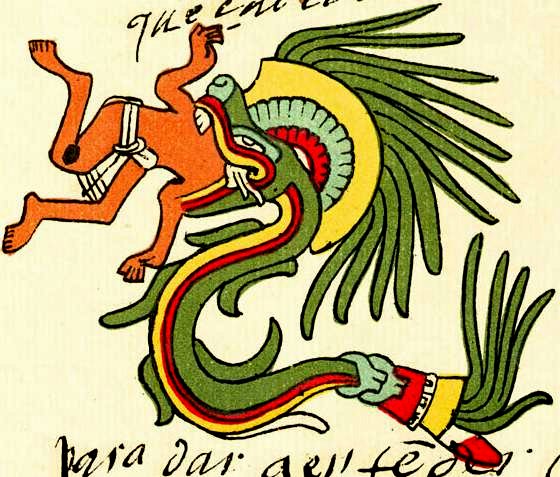
Quetzals have been worshipped as gods of the air and wealth (their feathers have been very valuable from time to time) and freedom (because until recently they've always died in captivity). They've also been associated with the snake god quetzalcoatl (the coatl bit means serpent):


Mayan legend says that the quetzal helped fight the Spanish conquistadores, and that before the conquest of Latin America by the Spanish the quetzal used to sing beautifully, but that it will never sing again until the land is truly free (the noise it makes now has been likened to a whimpering puppy).

Finally, as well as being gods, quetzals are equal-opportunity birds.  Quetzals share the child-care, the male generally doing the day-shift when it comes to hatching the eggs, and the female the night-shift.

All that, and just so very beautiful, too:

Pharomachrus auriceps, Golden-headed Quetzal.jpg

Photo of Golden-headed Quetzal (apparently, though I see no gold on the head) by Joao Quental - Flickr, CC BY 2.0, https://commons.wikimedia.org/w/index.php?curid=36026745

Terrific beasts, anyway.

Thing To Consider Today: the quetzal. The plural of this word can be either quetzals or quetzales, and the word comes from the Nahuatl quetzalli, which means large brilliant tail feather. The quetz bit means stand.


Thursday, 1 September 2016

The ultimate predator: a rant.

I watched a TV programme called Earth's Mythical Islands the other day. It was about the wildlife of New Zealand. The pictures were lovely, and the commentary was read impressively by Sam Neill.

In this super-saturated environment, drawled Sam, huskily, as the screen focused on another stretch of wet undergrowth, this specialised snail is the Ultimate. Predator.


photo (not from the programme) by Mike Dickison

Ultimate predator? 

A snail? 

Admittedly it was a Powelliphanta snail that can grow to the size of a man's fist, and admittedly the sight of it sucking up an earthworm like spaghetti was outstandingly gross, but...it was a snail! Apart from the fact that most of the poor things get eaten by brushtail possums, pigs, hedgehogs, rats and the native weka:

File:Weka-fledgling 1.JPG
photo by Duncan Wright


you just see what happens when a cow stands on it!

Look, if you want to impress me then tell me some facts. Tell me that it lays bean-sized eggs with shells like bird eggs; tell me that it's unique to New Zealand; tell me how very very rare and threatened it is, and how its shell cracks if it gets dry. 

But don't try and tell me it's a sort of molluscan equivalent of a Bengal tiger, because it isn't.

And anyway, the reality is absolutely marvellous.

Word To Use Today: snail. This word comes from the Old English snægl.