This blog is for everyone who uses words.

The ordinary-sized words are for everyone, but the big ones are especially for children.


Tuesday, 7 February 2017

Thing To Do Today: have pity.

There's more than one place in England called Pity Me, but the one I know is in County Durham. It was there that I was told about the bus driver, who, encountering a priest who asked for Pity Me, Single, replied Pity me, Father: married!

Well, it amused me at the time.

Where the name of the place Pity Me originates, whether from French or Latin or English, is discussed HERE, but the story I like best is that the monks taking St Cuthbert to his final resting place in Durham Cathedral dropped his coffin, upon which an irritated voice from the coffin ordered the monks to pity me.

Pity seems to have gone out of fashion lately in favour of empathy. I think this is, well, a pity. I know the saying no one wants to be pitied, but, as Charlie Brown says, there are times when I'll take all the pity I can get.

The great advantage of pity, however, is that it encourages us to take pity on others. 

Of course empathy (and its rather old-fashioned sister sympathy) encourage us to do something, too, but it's mostly to admire our own sensitive navels.

So go on: put a penny in the box.

Well, it's a start, isn't it.

Thing To Do Today: have pity. This word comes from the Old French pité, from the Latin pietās, duty.


Monday, 6 February 2017

Spot the Frippet: pith.

Well, this is an easy spot, isn't it? Just scrape the coloured bit off a citrus fruit and there's the pith.

As for a pith helmet, that explorers used to wear to protect their heads from the sun: 

File:Pith helmet - Royal Canadian Military Institute - Toronto, Canada - DSC00325.jpg
photo by Daderot

presumably that's stuffed with orange skin (I mean, the thing does seem to come with its own juicer).

Sadly, though, this isn't the case. Pith helmets are either made of cork or stuffed with the insides of the sola plant (hence the pith helmet's other name of sola toupee*, which I always assumed was something to do with toupees and the word solar, but isn't**).


Even more sadly, the bits of the sola plant that are used to stuff a pith helmet aren't really pith at all, but a very soft and light sort of wood. Pith is the spongy stuff sometimes found inside youngish shoots, importantly those of the sago plant, which, after processing (it's poisonous) gives us a milky pudding.

The soft insides of a bone or feather can be called the pith, too - and so can the centrally important part of an argument.

Mind you, spotting one of those in this post will be quite impossible.

Ah well!

Spot the Frippet: pith. This word comes from the Old English pitha.

PS: A reader has contacted me via Twitter to point out that sago only makes a milky pudding if you add milk to it. This is true. 

*I'm obviously still confused. I meant topi, here.

**Topi is the Hindi for hat, and toupee is from the Old French toupet, forelock.


Sunday, 5 February 2017

Sunday Rest: murage. Word Not To Use Today.

Murage?

Look, the mur bit sounds like a dyspeptic cow, and the rest rhymes with sewage.

I mean, what's to like?

Murage is a payment demanded for the construction or maintenance of a boundary wall. 

Luckily that sort of thing is so out-of-date that in my dictionary the word is labelled archaic.

Still, if you should happen to need such a term, then I would imagine that the dyspeptic-cow-and-sewage thing is probably the least of your problems.

Sunday Rest: murage. This word comes from Old French, and before that from the Latin word for wall, which is mūrus.


Saturday, 4 February 2017

Sing a Song of Sixpence: traditional.

Sing a song of sixpence
A pocketful of rye
Four and twenty blackbirds
Baked in a pie
When the pie was opened 
The birds began to sing
Wasn't that a dainty dish to set before the king?

The king was in his counting-house
Counting out his money
The queen was in the parlour 
Eating bread and honey
The maid was in the garden
Hanging out the clothes
When down came a blackbird and pecked off her nose

She made such a commotion 
That little Jenny Wren
Flew down into the garden
And popped it on again.

Oh, the fascination and horror of this rhyme! Oh, the horrible cold conviction that the last verse has been tacked on afterwards to make it slightly less nightmarish (look, it doesn't even fit the rest of the rhyming-scheme)!

How can the birds sing when they've been baked? (I still don't know, but pies containing live birds were made and served to kings in mediaeval times.)

Was the maid the one who put the birds in the pie? If not, why is she the one to suffer?

I don't know any of the answers (and nor, I believe, does anyone else) but people have been guessing about this rhyme for a long time. The blackbirds might be rooks, the young of which do make a nice pie (or so I've been told); or they might be monks, and the king and queen the sun and the moon. Or the queen might be Catherine of Aragon and the maid Anne Boleyn. The pocketful might be an old grain measure. Twenty four might be to do with the Bible, and the lost nose might really be a lost soul,

What do I think? 

I think that sometimes nothing is as important or effective as admitting with a shudder that we just don't know.

Word To Use Today: wren. This word comes from the Old English wrenna.


Friday, 3 February 2017

Word To Use Today: totem.

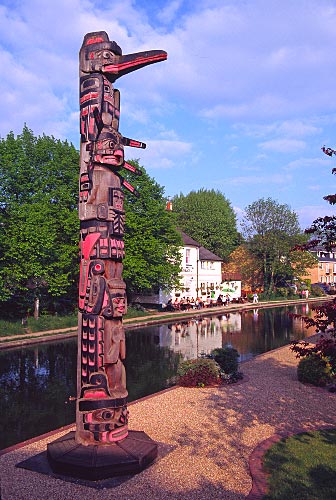
Traditionally, totems come on poles:


Totem Pole carved by Canadian First Nations Artist Henry Hunt. (It was commissioned in gratitude to the Kwakiuti community of Vancouver Island for saving timber merchant William John Alsford from starving during a strike. This pole is to be found next to the Grand Union Canal near William Alsford's home in Hertfordshire, England.) 

But you can get totems in all sorts of places and guises. A totem is a bit like a mascot:

File:Zampa the Lion 125 Anniversary.JPG
photo of Millwall Football Club mascot Zampa by NoOneLikesUs (talk) 

The difference is that while a mascot is a fellow supporter, a totem is to some extent a personification (animalification?) of the group it represents. It's quite likely to be sacred, too.

A totem can be an bird:

File:Raven on top of a totem pole.JPG
photo by Leonard Kaplan

 a plant, an object (like a mountain or river) or even something as unrepresentable as a wind.

I don't know what my own totem is, but I have a feeling there might be one out there somewhere waiting to be discovered.

Have you discovered yours, yet?

Word To Use Today: totem. This word comes from the Ojibwa nintōtēm, which means mark of my family.


Thursday, 2 February 2017

A handy way with meetings: a rant.

Dan Carley has a position in a British Government Department (or institution or service or something) called 'Platform as a Service'. I'm told it's something to do with the cloud.

(Platform as a Service? Good grief, I can feel my blood pressure rising already, and this rant isn't even about that.)

Anyway. Mr Carley, tired of noisy arguments and irrelevances at much-too-long meetings, has devised some hand signals to quieten things down and speed things up.

If you agree with someone, you signal this by holding your hands with both palms facing upwards; disagreement, logically enough, by two palms held downwards; wanting to speak by one palm held up; direct response by fingers in the shape of a gun; a request for clarification by the fingers of one hand making a C shape; and a point of order by a two-handed diamond shape.

After some months' trial the system is apparently working well: people can finish want they want to say without interruption.

But...hey, hang on! Surely Mr Carley is re-inventing the wheel, here. What's wrong with the traditional extended nodding and soft grunts that signals agreement in meetings? Or the rolling-eyes, heavy sigh and contemptuous snort of disagreement? 

One hand held up has indicated a desire to speak (or be excused) for many years; and as for the request for clarification, the screwed-up face and head-scratch with a forefinger speaks at least as loudly as words.

As for the direct response and the point of order, they may not already have established body-language forms, but I don't see how these can be effective without actually, well, speaking...

...hey, I don't know, though...

...charades?

Word To Us Today: charade. This word is French for entertainment. Pleasingly, given the circumstances, it comes from the Provençal charrado, chat, from charra, chatter, an imitation of the sound chatter makes.


Wednesday, 1 February 2017

Nuts and Bolts: a sexy syllables.

No, no, sexy syllables are really a thing: if you're trying to woo a lady they've even been proved to help.

Well, they've been proved to help if you're a songbird, anyway.

The nub of the matter is, what do birds like in a song? 

For a long time the answer was thought to be a matter of variety.  I suppose this was analogous with humans, where a man who can talk about music, current affairs and fashion is generally regarded as more fascinating than one who talks about steam trains the whole time.

As it turns out, though, this is not the case with song birds. Female birds prefer one song sung really very well indeed to lots of songs sung indifferently. 

Which, if you think about it, is also analogous with humans.

So, what counts as singing well? 

It may be a matter of the speed of the trills, or the complexity of the song, or the singing in the local accent (yes, songbirds do have accents), or just the sheer loudness. 

Or, if you're a canary, sexy syllables.

A sexy syllable is one where a bird uses its syrinx (that's the avian equivalent to our larynx) to sing two notes at once.

This isn't easy for a human, but something similar can be achieved (and often is) with the help of other singers (I note that groups of singers have been known to prove attractive to young females). 

File:One Direction at the Logies Awards 2012.jpg
photo of One Direction by Brett Robson – Global Photographics

If this is hard to arrange then a guitar might help. Or even a recording of some kind.

In fact, the idea of sexy syllables might explain rather a lot, mightn't it?

Word To Use Today: syllable. This word comes from the Greek sullabē, from sullambanein, to collect together.