This blog is for everyone who uses words.

The ordinary-sized words are for everyone, but the big ones are especially for children.


Friday, 7 April 2017

Word To Use Today: tansy.

Here's a lovely dancing word.

Tansy is a wild flower, native to Europe and Asia, but introduced to America and elsewhere.


So why would anyone introduce a wild flower into their homeland? Isn't a wild flower just a weed that's been noticed by a poet?

Well, tansy is useful stuff. It's said to be good for killing intestinal worms and preventing flatulence (especially valuable during Lent, apparently, when people aren't allowed meat and so tend to fill up with beans). Putting some in your bath water is said to cure joint pain, and it's still approved in the USA for treating fevers and colds.

Tansy is a good insect repellent, too, and has been rubbed on meat for this purpose (not recommended, as tansy can be poisonous) and also used at funerals (eerrgghh). If you plant tansy with potatoes then Colorado beetles tend to turn up their noses (proboscides?) and go elsewhere, and if you wear it round your neck then mosquitoes tend to bite someone else.

You can make omelettes with tansy (if you're prepared to risk being poisoned) and tansy sweets might even help your gout.

But the best reason to use the word tansy is because it is a word that dances.

Quite possibly the can-can if you try eating it.

Word To Use Today: tansy. This word comes from the Mediaeval Latin athanasia, from the Greek word meaning immortality, because it was believed to prolong life.

So now you know why there are no Ancient Greeks left around.


Thursday, 6 April 2017

A Good School: a rant.

I wrote about DNA the other day, and how the glory of you, you yourself, can be described in an alphabet of just four letters (though I'm afraid one of the letters means, basically, bird poo). 

The only problem with this alphabet is that the text turns out to be rather lengthy (my post can be found HERE).

But what about if you don't have much space to get your message across? What if all you have is, say, the back of a bus?

I found myself travelling behind the minibus of a local fee-paying school last week. It had a slogan on the back, presumably aimed at the parents of prospective pupils.

It said:

Happiness, Confidence, Success


This was was a bit odd, I thought, because I surely the purpose of a school is to keep the kids safe and get them to learn lots of stuff.

Still, I suppose the people who run the school have a deeper philosophical attitude than that.

Something along the lines of a fool and his money is soon parted, perhaps.

File:Schoolchildren reading 1911.jpg

Word To Use Today: success. This word means a favourable result, though it used to mean any result. The word appeared in English in the 1500s and came from the Latin succēdere, to succeed.


Wednesday, 5 April 2017

Nuts and Bolts: etymon.

Etymon is the Ancient Greek for truly, or really, and it describes a word (or part of a word) that's given rise over time to another. For example the word musth, the state of excitement a male elephant experiences during the breeding season, has as its etymon the Persian word mast, meaning drunk. 


File:African bull elephant Tanzania.jpg
photo by Geir Kiste

The idea is that if you look at the history of a word you will discover its true or real meaning. Unfortunately, as you can see with the musth example, it doesn't work.

What you will discover, though, is how people see (or have seen) the world. 

And what could be more fascinating than that?

Word To Use Today: etymon is Greek. It first appeared in English in the 1570s, when it held the idea not only of truth, but being primitive, as well.


Tuesday, 4 April 2017

Thing To Not Be Today: trepid.

Intrepid we know, but what about trepid?

It looks as if trepid should be intrepid's opposite, but what's the opposite of that? What's the opposite of the urge that encourages us to explore criminals' hideouts, mysterious pot holes, haunted houses and so many other challenging places, from beauticians' parlours to Korean dog restaurants?

For those of you who have come up with the words sensible or living, I say away with you!

In any case, trepid doesn't necessarily describe someone afraid to leave to confines of home, it just describes someone timid - probably too timid to risk using the word trepid, which might call attention to the essential selfishness and dullness of a life of, well, trepidation.

So: do something new. Take a different road home, or wear a hat, or try a new writer.

Try a new food (though I wouldn't try dog, myself); say what you think; wear false eyelashes. 

Dare to be different.

Just for once.

File:Morris dancer, York (26425183210).jpg
photo by Tim Green

Thing Not To Be Today: trepid. This word comes from the Latin trepidus, fearful or timid.


Monday, 3 April 2017

Spot the Frippet: hexagon.

A wonderful thing is the hexagon. Most of the ones we see around us are regular, that is they have sides of equal length (which happens to means that their angles are of equal size, too: 120 degrees, or a third of a circle).

The nearest hexagon to you might be on a nut (a nut-and-bolt type nut, I mean, not your nearest almond or idiot) but when we think of webs of hexagons we often think of honeycombs:

File:Honeycomb structure (6248780733).jpg
photo  by Gavin Mackintosh

Much thought has been given to how bees can manage to produce such perfect hexagons, but I'm afraid the answer that seems likeliest to me is that what they're doing is placing tubes of soft wax as close together as possible, and this means they automatically end up squashed together into perfect little hexagons.

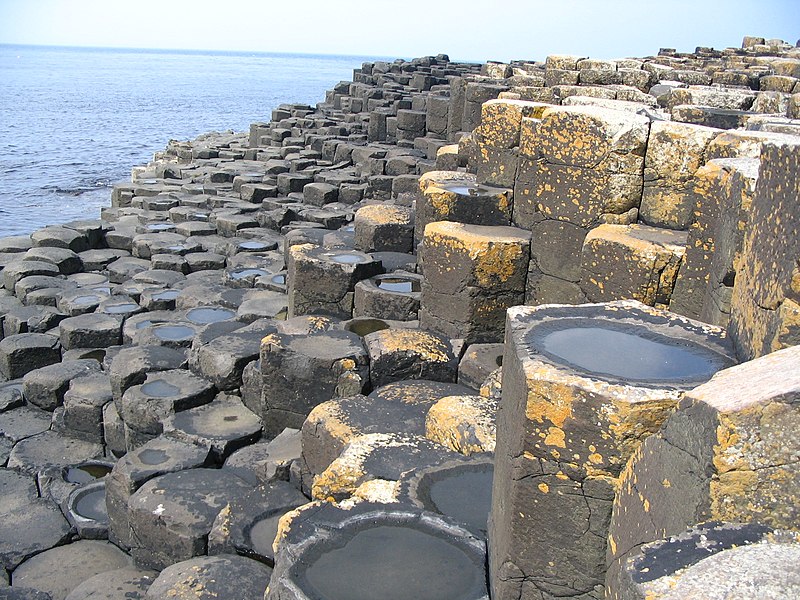
I don't think the Giant Finn McCool (who was, let's face it, a great idiot) put a lot of scientific thought into making the hexagons of his causeway, either:

File:Giants Causeway cellules polygonales.JPG
photo by Patrice78500

Where else can you see hexagons? On the skin of a custard apple:

File:A scene of custard apple.JPG
photo by Thamizhpparithi Maari

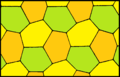
which just goes to show that irregular hexagons can be fitted together, too (this mind-bending example below, and several others, can be found HERE:


Isohedral tiling p6-11.png

Where else?

Lots of places, probably.

How about having a good look at your nearest pencil?

Spot the Frippet: hexagon: The Greek for six is hex. The -gon bit comes from the Greek gōnia, angle.


Sunday, 2 April 2017

Sunday Rest: under-hung. Word Not To Use Today.

I love the works of Jane Austen, and I completely accept (and mostly enjoy) the fact that language changes constantly (especially now I'm old enough to have seen so many hideous words and expressions slip into merciful obscurity): but, really, Sir Walter Elliiot's description in Austen's Persuasion of his kinsman Mr Walter Elliot took me aback a bit:

He did justice to his very gentlemanlike appearance, his air of elegance and fashion, his good-shaped face, his sensible eye; but, at the same time, "must lament his being very much under-hung...".

Apparently it means that Mr Elliot's had a projecting lower jaw.

Gosh, but it's a word to be careful with, isn't it.

Word Not To Use Today: underhung. This word tends not to have anything to do with jaws, nowadays. It may describe meat that's tough because it's been cooked too soon after slaughter, or a door that slides on runners.

Or may not.


The word hang comes from the Old English hangian, which meant the same thing.


Saturday, 1 April 2017

Saturday Rave: being Elizabeth Goudge.

Elizabeth Goudge was a middle-class maiden lady who wrote novels for adults and children. 

She won the Carnegie Medal for her children's book The Little White Horse, but she didn't receive very much praise for her adult work. Her 1956 work The Rosemary Tree, for instance, was criticised in the New York Times for its sentiment and 'slight plot'.

This contrasted starkly with the reception given to a 1993 novel called Crane's Morning, by Indrani Aikath-Gyaltsen, which was, according to the Washington Post, 'exquisite' and 'breathtakingly new'.

Well, it might have been exquisite, but it certainly wasn't new. Crane's Morning was set in an Indian Hindu village, but apart from the setting and the names it was copied, sometimes word for word, from Elizabeth Goudge's The Rosemary Tree.

This was a rotten trick if ever there was one, and it's made even more rotten by the fact that Aikath-Gyalten died in not entirely clear circumstances (suicide? neglect?) quite soon after the facts of the plagiarism became known.

You have to be careful with tricks, you know.

But let me leave you with something happier. Elizabeth Goudge died on April Fool's Day 1984, but in her books she found a way of bringing us joy and truth from beyond the grave.

As she said:

'This world...needs to be reminded that the old fairy stories are rooted in truth, that imagination is of value, that happy endings do, in fact, occur, and that the blue spring mist that makes an ugly street look beautiful is just as real as the street itself.'


Word To Use Today: beautiful. This word comes from the Old French biau.