Ptochocracy is hard to say (tockOCKcrassee), hard to spell, and very hard to find in the dictionary.
But still, as it means government by the poor, the chances of any of us having to use it are very small indeed.
Wird Not To Use Today: ptochocracy. This word is Greek, and comes from ptochos, poor, plus kratos, power.
Sunday, 7 May 2017

Saturday, 6 May 2017
Saturday Rave: the penny black.
On 6th May 1840 the first postage stamp as we know it today (more or less) was put into use. (They were sold from the beginning of the month, but you couldn't use them before the sixth.)
It looked like this (only smaller).

The lady in the image is Queen Victoria, the place was Britain, and the man who did all the administration and arrangements was Rowland Hill.
Who invented the idea of the stamp is hotly contested (some of these stamp collectors are men of high passions, you know) but William Dockwra and Robert Murray established a pre-paid London penny post in 1680 where proof of payment came in the form of a design hand-stamped on the letter or package. It looked like this:

This seems to be why a stamp is called a stamp.
Other inventors of the idea of the postage stamp include the Slovenian Lovenc Košir and the Scot James Chalmers - but it was Rowland Hill who got all the paperwork and persuasion and admin done and finally got the idea adopted.
The new (outside London) pre-payment system was a great advantage to the people delivering the letter: first, payment was guaranteed; and, second, the sender had an incentive to restrict the size and weight of the item to be sent.
In fact it meant that letters became so easy and cheap to send that even quite poor people could keep in touch: and so my grandfather, in about 1910, could send a postcard to his sweetheart, my grandmother, which simply said see you tonight.
Word To Use Today: stamp. The Old English word was stampe, which referred of course to the foot sort of stamping.
It looked like this (only smaller).
The lady in the image is Queen Victoria, the place was Britain, and the man who did all the administration and arrangements was Rowland Hill.
Who invented the idea of the stamp is hotly contested (some of these stamp collectors are men of high passions, you know) but William Dockwra and Robert Murray established a pre-paid London penny post in 1680 where proof of payment came in the form of a design hand-stamped on the letter or package. It looked like this:
This seems to be why a stamp is called a stamp.
Other inventors of the idea of the postage stamp include the Slovenian Lovenc Košir and the Scot James Chalmers - but it was Rowland Hill who got all the paperwork and persuasion and admin done and finally got the idea adopted.
The new (outside London) pre-payment system was a great advantage to the people delivering the letter: first, payment was guaranteed; and, second, the sender had an incentive to restrict the size and weight of the item to be sent.
In fact it meant that letters became so easy and cheap to send that even quite poor people could keep in touch: and so my grandfather, in about 1910, could send a postcard to his sweetheart, my grandmother, which simply said see you tonight.
Word To Use Today: stamp. The Old English word was stampe, which referred of course to the foot sort of stamping.
Friday, 5 May 2017
Word To Use Today: puckerood.
What does puckerood mean?
Well, what do you think?
It sounds like what happens when someone's puckered up for a kiss only to be fobbed off with a twitched eyebrow, a frosty Good Morning! and a brisk handshake (and now I come to think about it we really need a word for that) but sadly puckerood means to be absolutely shattered, or to be ruined.
It's a New Zealand word, but the Kiwis are a generous lot and I'm sure they wouldn't mind the rest of us borrowing it.
Perhaps we could even use it as an excuse not to kiss people.
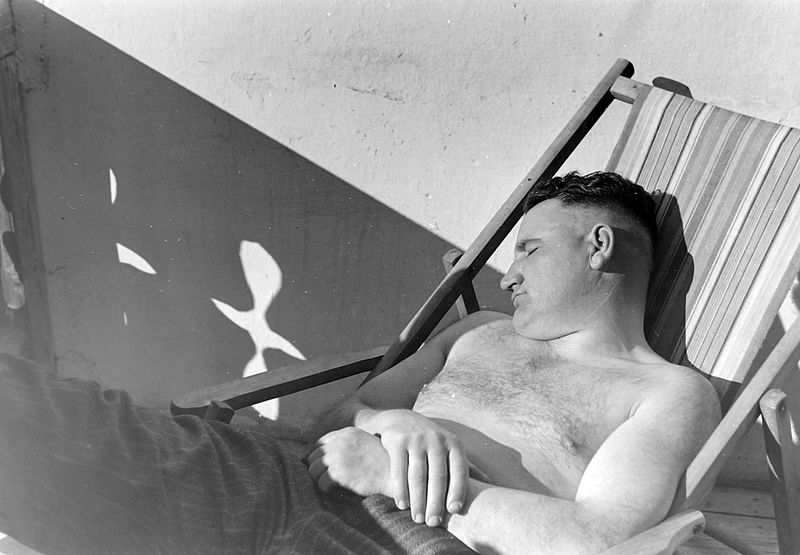
photo: Foto fortepan ID 15607, Wein Sarolta
Word To Use Today: puckerood. This word comes from the Māori pakaru to shatter.
Well, what do you think?
It sounds like what happens when someone's puckered up for a kiss only to be fobbed off with a twitched eyebrow, a frosty Good Morning! and a brisk handshake (and now I come to think about it we really need a word for that) but sadly puckerood means to be absolutely shattered, or to be ruined.
It's a New Zealand word, but the Kiwis are a generous lot and I'm sure they wouldn't mind the rest of us borrowing it.
Perhaps we could even use it as an excuse not to kiss people.
photo: Foto fortepan ID 15607, Wein Sarolta
Word To Use Today: puckerood. This word comes from the Māori pakaru to shatter.
Thursday, 4 May 2017
Being fruity: a rant
I was looking for somewhere to visit over the Easter weekend when I came across an intriguing event on www.wherecanwego.com.
Conexion [sic] & Contact...Desire...in Waltham Cross.
Learn to connect with yourself, and embrace your pears. Disconnect your mind, an let you go. Listen to your body, your senses, your feelings. Learn to improve your relations...
Well, most of my relations could do with a bit of improving, so I made a bee-line for the fruit bowl and had a go at embracing some pears.
I think I must have been doing it wrong, though, because none of my family show any signs of becoming less eccentric.
Ah well.
I probably needed to go to the event.
Word To Use Today: pear. The Old English word for pear was pere, and before that the Latin was pirum.
Wednesday, 3 May 2017
Nuts and Bolts: words beginning with vr.
When you think how many people's very first word is vroom! it's surprising that English has so few words using the sound vr.
There's vraisemblance, which we've borrowed from French, but generally we say verisimilitude instead, a word less huskily elegant than vraisemblance and more...silly. But, hey, there's the English for you.
Then we have some words borrowed from Africaans: vrot, meaning rotten or putrid; vrou, a woman or wife; and vrystater, a native of the Free State. Sadly, though, those are all really pronounced fr, not vr.
There are some words of now-no-longer-used Middle English: Vryday (Friday) vram (from) vreo (free); and there are some obscure dialect words: vraic (seaweed, as in wrack), vreend, friend, and vrocht (work); but they're too similar to our current versions to be useful.
That leaves us with just two words: vriester, which means a girl (or did, once, in about 1650) and vril, which is more interesting.
Vril is a mysterious electromagnetic substance invented by Edward Bulwer-Lytton in his 1870 best-seller The Coming Race. The coming race in question, the Vril-ya, have supernatural powers derived from vril.
If this seems about as obscure as the other vr words, then I direct you to Bovril:

photo from GFDL
This is a tarry substance popular in Britain. It is very much like yeast-extract (though made from beef). The Bo- bit implies that it's to do with bovine animals (Latin bos, ox) and the vril lays claim to supernatural powers.
How the makers manage to get away with it I just can't think.
Word To Use Today: one with a vr in it. Vraisemblance is to do with the French vrai, which means true. Vrou is basically the same word as Frau. Vriester comes from the Dutch vrijen, to woo. But, really, the only words that are usable of all these are Bovril and vroom.
There's vraisemblance, which we've borrowed from French, but generally we say verisimilitude instead, a word less huskily elegant than vraisemblance and more...silly. But, hey, there's the English for you.
Then we have some words borrowed from Africaans: vrot, meaning rotten or putrid; vrou, a woman or wife; and vrystater, a native of the Free State. Sadly, though, those are all really pronounced fr, not vr.
There are some words of now-no-longer-used Middle English: Vryday (Friday) vram (from) vreo (free); and there are some obscure dialect words: vraic (seaweed, as in wrack), vreend, friend, and vrocht (work); but they're too similar to our current versions to be useful.
That leaves us with just two words: vriester, which means a girl (or did, once, in about 1650) and vril, which is more interesting.
Vril is a mysterious electromagnetic substance invented by Edward Bulwer-Lytton in his 1870 best-seller The Coming Race. The coming race in question, the Vril-ya, have supernatural powers derived from vril.
If this seems about as obscure as the other vr words, then I direct you to Bovril:
photo from GFDL
This is a tarry substance popular in Britain. It is very much like yeast-extract (though made from beef). The Bo- bit implies that it's to do with bovine animals (Latin bos, ox) and the vril lays claim to supernatural powers.
How the makers manage to get away with it I just can't think.
Word To Use Today: one with a vr in it. Vraisemblance is to do with the French vrai, which means true. Vrou is basically the same word as Frau. Vriester comes from the Dutch vrijen, to woo. But, really, the only words that are usable of all these are Bovril and vroom.
Tuesday, 2 May 2017
Thing To Do Today: yabber.
You know the idea that animals develop similar features if they have to make a living from the same sort of environment?
Kangaroos and deer, for instance, have quite similar grass-nibbling heads even though they're not even forty-fifth cousins.
Well, words can be a bit like that, and yabber is a rather lovely example.
Yabber is a fabulous Australian word which means talk, or, as we've been saying in English since the 1400s, jabber.
Yabber can be used either to describe the action of having a yabber, or the talk itself.
Yabber and jabber. Is the similarity a coincidence? Well, I doubt it, though the words don't seem to be any more related than deer and kangaroos.
But still, the thing is, do we want to yabber? Isn't it a bore when someone starts yabbering on?
Well, sometimes. But in a word of computers I'm beginning to think of it as more and more of a luxury, and so personally I find I'm all for it.
Yabba dabba doo!
Thing To Do Today: yabber. The chances are that this word comes from the Australian native Wuywurung language, in which yaba means to speak.
Monday, 1 May 2017
Spot the Frippet: something psittacine.
Psittacine (you don't say the p) means to do with, or resembling, a parrot.
(Parrots here includes budgies, cockatoos and macaws etc.)
But what resembles a parrot apart from a parrot?
Disappointed British footballers are often said to be as sick as a parrot, so I suppose they're suffering from psittacine levels of nausea or chagrin.
Parrots are famous for repeating themselves, and there are plenty of people around who exhibit psittacine levels of that.
Parrots are also said to mummify in death, and though I doubt if many of us have access to actual mummies, you might find something similar to one hiding at the back of the vegetable rack.
And is that ear-splitting screech a real parrot, or is it coming from your local playground?
Of course parrots are celebrated, more happily, for their gorgeous colours. Look out for someone in scarlet:

scarlet macaw, photo by Murray Foubister
electric blue:

hyacinthine macaw, photo by Bernard DUPONT
lime green:

thick-billed parrot, photo by Ltshears
or the sunniest yellow:

orange-bellied parrot, photo by JJ Harrison (jjharrison89@facebook.com)
And that's not even the only way a person can resemble a parrot:

photo by Gexon
And that's not to mention noses...
Spot the Frippet: something psittacine. This word comes from the Latin psittacus, parrot.
(Parrots here includes budgies, cockatoos and macaws etc.)
But what resembles a parrot apart from a parrot?
Disappointed British footballers are often said to be as sick as a parrot, so I suppose they're suffering from psittacine levels of nausea or chagrin.
Parrots are famous for repeating themselves, and there are plenty of people around who exhibit psittacine levels of that.
Parrots are also said to mummify in death, and though I doubt if many of us have access to actual mummies, you might find something similar to one hiding at the back of the vegetable rack.
And is that ear-splitting screech a real parrot, or is it coming from your local playground?
Of course parrots are celebrated, more happily, for their gorgeous colours. Look out for someone in scarlet:
scarlet macaw, photo by Murray Foubister
electric blue:
hyacinthine macaw, photo by Bernard DUPONT
lime green:
thick-billed parrot, photo by Ltshears
or the sunniest yellow:
orange-bellied parrot, photo by JJ Harrison (jjharrison89@facebook.com)
And that's not even the only way a person can resemble a parrot:
photo by Gexon
And that's not to mention noses...
Spot the Frippet: something psittacine. This word comes from the Latin psittacus, parrot.
Subscribe to:
Posts (Atom)