This blog is for everyone who uses words.

The ordinary-sized words are for everyone, but the big ones are especially for children.


Tuesday, 14 August 2018

Thing Not To Do Today: grill.

The fashion in cookery at the moment seems to be for recipes without nearly enough food in them. 

(Note to food journalists: lettuce, however ornamented, is not enough!)

Still, fashions come and go. A little while ago we were being asked to put chilli in absolutely everything, and before that (when fat was the enemy) we were supposed cook everything under the grill.

But grilling things is a nuisance. Half the time the flame on a grill is too far away from the food for it to be much more than a sun bed (even when the grill pan is propped up on two chopping boards) and apart from that you can't see what's going on, you can't get to your oven without doing contortions, and the washing up is horrendous.*

In any case, the fat's the best part.

A barbecue grill, I admit, is a slightly more convenient. It does at least incinerate the flies to something that can pass as charcoal.

There is another sort of grilling, one which involves asking searching, inescapable questions. It's occasionally permissible, and even charming, in a really curious three-year-old. 

Otherwise it's the realm of policemen, inquisitors, and tax collectors, and best avoided.

Thing Not To Do Today: grill. This word comes from the Old French gril, gridiron, from the Latin crātīcula, fine wickerwork.


*This may be just my cooker. 

I'm getting a new one.


Monday, 13 August 2018

Spot the Frippet: hottie.

In Great Britain it's not at all remarkable for even quite old people take a hottie to bed with them half the nights of the year.


File:Helen Kane and Betty Boop - Photoplay, April 1932.jpg


Mind you, in Great Britain a hotty or hottie is a hot water bottle.

Spot the Frippet: hottie/hotty. This word comes from the Old English hāt. The Gothic heito means fever


File:Wärmflasche1.jpg
photo by Peng


(In the USA a hottie is a fanciable person.)


Sunday, 12 August 2018

Sunday Rest: exude. Word Not To Use Today.

It's possible to exude a sense of optimism, but there's something about the word exude that reminds me, even in this instance, of horrid things like diseased and depraved clowns.

Most other things people exude I really don't want to think about. 

Ugh!

Still, it's a horrid word for a horrid thing, so I suppose at least it's honest.

Sunday Rest: exude. This word comes from the Latin exsūdāre, from sūdāre, to sweat.

Lovely.


Saturday, 11 August 2018

Saturday Rave: The Mesoamerican Long--Count Calendar.

Let's face it, our Western calendar system is rubbish.

Not only does it work in two directions, forwards and backwards, centring on a date that almost certainly isn't the date of the birth of Jesus Christ, but everything is counted in bonkers ways.

We have millennia, centuries, and years, which is, fair enough, a practical sort of a system, but then some idiot has divided the year into unevenly-sized months (only one of which is the same length as an actual month, that is a lunar cycle - and that's only once every four years).

Then the month is divided into various odd numbers of days, the day into twenty four hours, the hours into sixty minutes, and the minutes into sixty seconds. 

Below that we go into milliseconds and things start to make sense again.

But the plain fact is that this is such a crazy and difficult system that we have to have a parallel system called a week which ignores all of this, just to give ourselves regular breaks.

The Mesoamerican Long-Count calendar begins, quite logically, on the day the world of human beings began to be formed. That, according to the Maya, was August 11 3114 BC. On this day some gods set up three stones at a place named First-Three-Stone-Place, and once everyone had a reference point then the sky could be raised and things generally put in order.

The Long-Count calendar therefore uses a one-direction numbering system. It's based on the number twenty, except that whereas in a pure twenty-base system the figures 100 equals twenty x twenty, or what we call four hundred, the Long-Count system has a quirk whereby the second digit from the right (and just the second digit from the right) rolls over to zero when it gets to eighteen...

And if you think that's daft, then consider: the second-digit-from-the-right rule makes the figure 100 equal 360, which is almost the number of days in a year.

And that's really rather neat and clever.


Word To Use Today: calendar. This word comes from the Latin kalendārium, which means account book. The kalends were the dates upon which debts became due.


Friday, 10 August 2018

Word To Use Today: noddy.

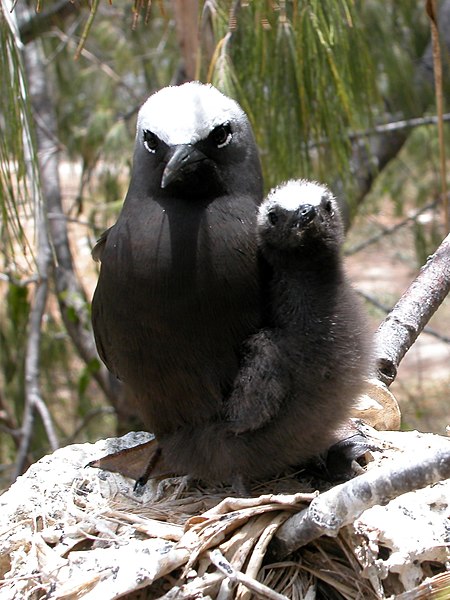
This is a noddy (and a baby noddy):

File:Black noddy and chick.jpg
Black noddy and chick. Photo by Glen Fergus

And so is this:

Noddy Goes To Toyland 1949 cover.jpg
(Noddy is the one in the blue hat.)

A noddy can also be a fool or a dunce. (Pleasingly, the genus name for the bird, Anous, is Greek for stupid.)

Something that's noddy is easy even for a noddy to use or understand.

Then there are noddies, which are shots of a TV interviewer reacting to his interviewee, and a single example of this sort of shot is a noddy. This word is to do with the word nod, as in moving the head up and down.

If I use this word today then I'd probably choose to talk about the birds. Oh, the poor birds. The Brown noddy has the scientific name Anous stolidus. As we know, anous is the Greek for stupid - and, I'm afraid, stolidus is the Latin for stupid. 

In what way are noddies so foolish? Well, they are well-known for ignoring predators - even humans - to the extent that they can be picked up by hand from their nests.

To be fair, though, there really are a lot of them, so they must be doing something right.

Word To Use Today: noddy. Enid Blyton's character isn't very bright, but he's called Noddy because he nods a lot, which sets the bell on his hat ringing. The word meaning foolish used to mean drowsy, and is probably linked to nod, the head movement. The interview shots are based on the same idea.

Noddy meaning easy is marked origin obscure, but, as I've said above, it might be linked to the idea of so easy even someone stupid could use it.


Thursday, 9 August 2018

Nothing wrong with that!: a rant.

I know it's ridiculous that the British government's second house isn't elected, and consists of people bearing the titles Lord or Lady, but the system does mean that the Lords tend to be old, and this (and the title) tends to make them feel obliged to be gentlemanly in speech. 

It can be quite refreshing.

Anyway, David Owen, who used to be Foreign Secretary in the House of Commons but is now one of the Lords, was interviewed for the Daily Telegraph newspaper of 30 July 2018. Lord Owen was giving his opinion of the present British Prime Minister, to whose party he has never belonged.

'I'm not going to criticise Mrs May,' he says (see? Always the gentleman, bless him) 'She was given an extremely difficult hand.' (Generous, too, even to an opponent. Isn't that typically lordly?) 'I think she has courage and she has persistence, (you can see, now, why I have an affection for the House of Lords, can't you?) 'but persistence can be very damaging,' (well, that's reasonable comment, and, after all, he has a job to do) particularly if it is basically blind-headed obstinacy.'

Oh.

Well...

...just think what he might have said if he wasn't a Lord...

...or had decided to be critical...

Word To Use Today: criticise. The Greek kritikos means capable of judging, and kritēs is a judge.


Wednesday, 8 August 2018

Nuts and Bolts: Oromo. Not as simple as ABC

Oromo is the most commonly-spoken first language in Ethiopia. 

There are Oromo speakers in nearby countries, too, and all together the language (or languages, because there are various varieties of Oromo) are spoken by about twenty five million people (though I've also seen that figure quoted as forty million).

The alphabet in which Oromo is written down is, and has always been, a deeply political thing.

The Oromo language was first written down by slaves in the 1840s, and these people used the Roman alphabet, but in the 1870s the conquest of Ethiopia by the Emperor Menelik gave rise to a decree that the Ge'ez script should be adopted by all the languages of the country.

That state of affairs carried on for about a hundred years but then, after a military coup, the written Oromo language switched back to the Roman alphabet again (the Roman alphabet was already being used by Oromo speakers outside Ethiopia, and it was also used in areas controlled by the Oromo Liberation Front). The switch back to the Roman alphabet happened in 1991.

But recently something odd has happened. The Oromo language is still written in Roman letters, but the order of the alphabet has been changed. It now starts L A G I M Aa* S.

The educational authorities claim that a USAID funded study on early literacy in Ethiopia recommended this change. The educational authorities, when challenged, also came up with an additional reason for starting the alphabet with an L: it's the commonest initial letter for Oromo words... 

...except that L isn't the commonest initial letter for Oromo words (it's actually thirteenth commonest: very close, as it happens, to L's traditional place in the alphabet, which is twelfth). Additionally, the USAID study didn't suggest that the order of the alphabet has anything to do with Ethiopia's literacy problems. (It largely blamed the habit of the children and the teachers of not turning up for school, and for the fact that even if you do turn up the schools have hardly any equipment.) 

So why has the change really happened? 

There are those who say it's to isolate Oromo speakers from the rest of the world, and so to disadvantage Oromo as a written language. There are those who say it's been done by people still sulking about the 1991 decision to revert to the Roman alphabet.

I don't know one way or the other. But I rather think that the limited amount of money the educational authorities have might be better spent not re-writing text books, but making sure that their schools have any books at all.

Word To Use Today: politics. This word comes from the Greek politēs, citizen, from polis, city.

*Aa is a long A sound, as in father.