The Saddlers Company was fined ten tuns of wine for their part in the great London brawl of 1327.
And you know how much a tun is, don't you.
No?
Well, a US ton (which is pronounced tun, naturally) is 2,000 lbs (lb is short for pound (yes, I know, but it just is, all right?! Blame the Romans!*) which is about half a kilogram), though a British ton is 2,240lbs. A metric ton (which is a term used in the US and many other parts of the world but not Britain, where it's called a tonne (pronounced, obviously, tun)) is, amusingly, 2,204lbs.
The size of a freight ton depends upon the stuff being shifted, but it can be a unit of either volume or weight. It can be 40 cubic feet (a cubic foot is 0,028 of a cubic metre) or one metric tonne.
But what about a tun?
That's definitely a unit of volume, and is either 252, 256, 240 or 208 wine gallons. A wine gallon is the area of a cylinder of 42 inches height and diameter. An inch is...
...sorry. I seem to lost the will to live.
Ten tuns of wine?
Ten big barrels.
That'll do.
Word To Use Today: ton or tun. Ton and tun both come from the Old English word tunne.
*lb is short for libra.
Thursday, 19 September 2019

Wednesday, 18 September 2019
Nuts and Bolts: penillion.
This word sounds like a number with a very large number of noughts, but it's not. It's something much more interesting.
Penillion is the Welsh art of singing poetry to the accompaniment of a Welsh traditional melody, usually played on the harp. The singer's (often improvised) tune may be in triple time while the harpist plays in duple time, and the harpist will often ;play variations on the traditional tune.
Here's a beautiful example:
Penillion often, as in that clip, forms part of the Welsh Arts competitions called Eisteddfodau.
Word To Enjoy Today: pennillion. This word is Welsh and means verses, from penill, verse. It's also called certhh dant, which means string music.
Tuesday, 17 September 2019
Thing Not To Tell Someone They Are Today: puisne.
You say puisne the same as you do puny (PYOOnee) and it's basically the same word.
The difference is that whereas puny usually means physically weak, puisne means not so powerful.
It's used for people who have too much authority and dignity to have sand kicked over them when sunbathing. Particularly judges.
There are times when calling someone in great authority puisne can be extremely refreshing.
Best not say it out loud, though.
Thing Not To Tell Someone They Are Today: puisne. This word comes from the Old French puisné, born later, from puis, at a later date, and né, born, from the Latin nascī.
Monday, 16 September 2019
Spot the Frippet: sundial.
There are quite a lot of sundials in England. Yes, it is quite bizarre, because we don't always have very much sun. Ah well!
You can find horizontal:

photo by SEWilco
and vertical sundials:

this one's in Paris. Photo by Ken Eckert
This one from New South Wales is a whopper (though it doesn't seem to be doing much good at the time of the photograph):

Singleton sundial. Photo by Bandworthy
My very favourite sundial is the topiary one at Ascott House in Buckinghamshire, England (follow the link to see a photograph). Around the clipped box numbers is the motto, also in clipped box hedging, Light and Shade But Love Always.
If you don't know where to find a sundial then if you have any sort of stick to cast a shadow you can make your own very easily. It'll only tell the correct time at that particular place at that particular time on that particular day of the year, but, hey, that's better than a clock which loses a second a day.
Or, of course, its battery.
Spot the Frippet: sundial. The Old English for sun was sunne. Dial comes from the Latin diālis, daily, from diēs, which means day.
You can find horizontal:
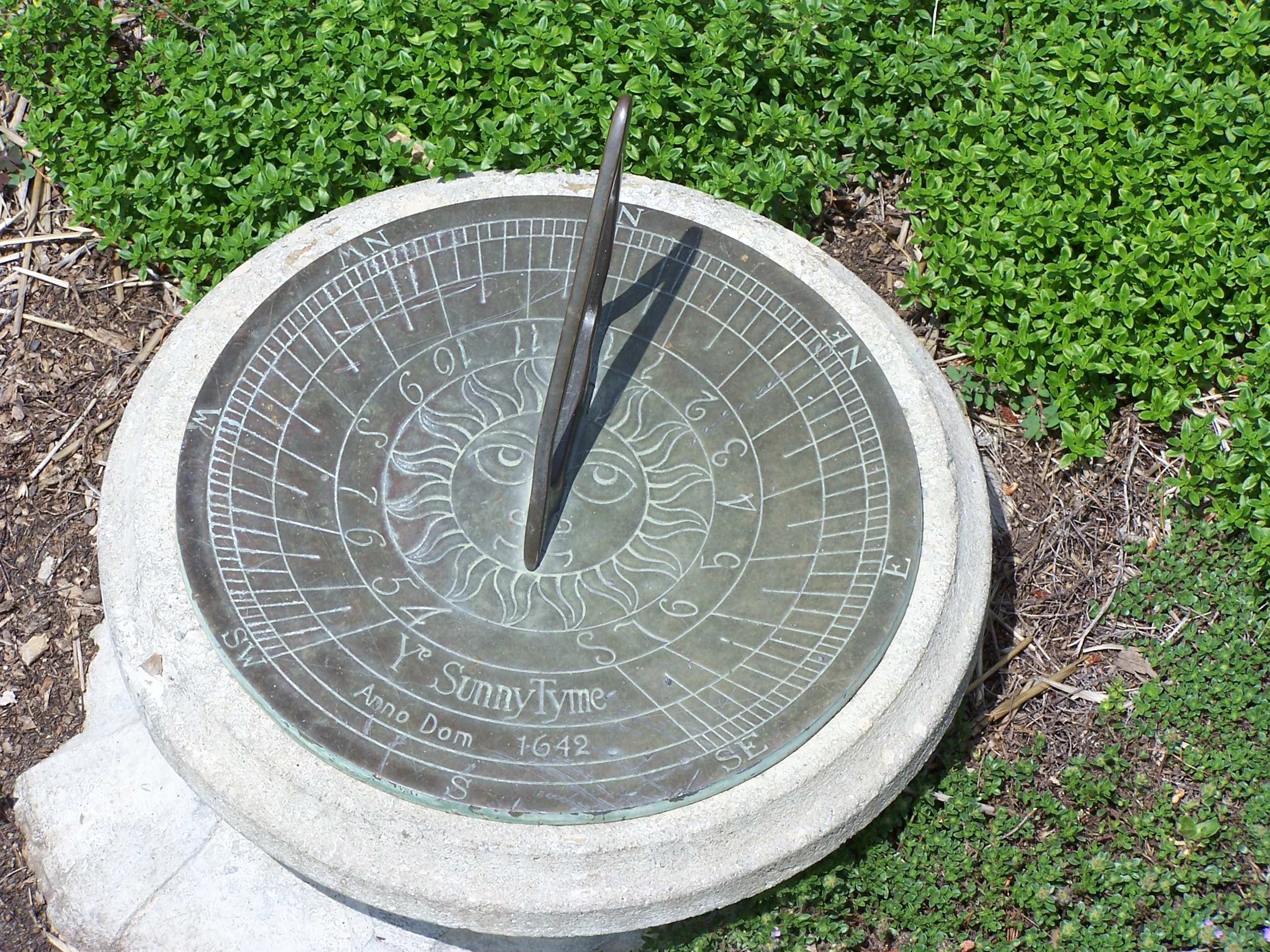
photo by SEWilco
and vertical sundials:

this one's in Paris. Photo by Ken Eckert
This one from New South Wales is a whopper (though it doesn't seem to be doing much good at the time of the photograph):

Singleton sundial. Photo by Bandworthy
My very favourite sundial is the topiary one at Ascott House in Buckinghamshire, England (follow the link to see a photograph). Around the clipped box numbers is the motto, also in clipped box hedging, Light and Shade But Love Always.
If you don't know where to find a sundial then if you have any sort of stick to cast a shadow you can make your own very easily. It'll only tell the correct time at that particular place at that particular time on that particular day of the year, but, hey, that's better than a clock which loses a second a day.
Or, of course, its battery.
Spot the Frippet: sundial. The Old English for sun was sunne. Dial comes from the Latin diālis, daily, from diēs, which means day.
Sunday, 15 September 2019
Sunday Rest: eutaxia. Word Not To Use Today.
A Greek scholar might guess that eutaxia is the state of enjoying things arranged neatly - and the rest of us the word might suggest the natural disgust felt at having to give money to the government.
But we would all be wrong, because eutaxia is actually an engineering term which describes something that can be easily melted.
Still, if you can find a work of literature which includes the sentence The butter existed in its usual state of eutaxia then you will at least have some idea what it's going on about, won't you.
Sunday Rest: eutaxia. Eu- is to do with the Greek word eus, which means good; -taxia, I should imagine, comes for the Greek word taxis, which means order.
What this has got to do with things melting I have no idea at all.
By the way, eutaxis is the state of having a fifth secondary flight feather.
This is, however, only likely if you are a bird.
Saturday, 14 September 2019
Saturday Rave: the book.
Not The Book, as in the Bible (though I can't deny it has some jolly good stuff in it) but the book - the multiplicity of paperback, hardback, cloth book, pop-up, illustrated, versified, mapped, indexed story of romance, betrayal, lust, greed, sacrifice, prejudice, war, romp, anguish, triumph, tragedy and all.
Michael Deacon has recently summed up the lure - well, one lure - of the book most economically and beautifully.
On the 24th August 2019 in the Telegraph newspaper he wrote:
That's what a book is, at heart: a refuge for introverts. It's a way to learn about life without having to take part in it. To learn about people, without having to touch them.
And he's right. Because there's nowhere safer, really, than a book.
Word To Use Today: book. This word comes from the Old English bōk. It's basically the same word as beech (as in the tree) because people used to write on its bark.
Friday, 13 September 2019
Word To Use Today: ostracon.
I love a really obscure word, and so I here give you the word ostracon.
(As a bonus, there's a word ostracod, too, but that's something completely different.*)
An ostracon is a potsherd (no, not someone who herds pots, but a broken piece of a pot used for writing on. It's an early example of recycling).

This one says Kimon Miltiades woz here, more or less.
In Ancient Greece ostraca were used in voting, and if the vote went the wrong way some unlucky person would end up ostracised. That's the meaning of the word ostracon which non-archaeologists are known to use.
But only very very occasionally.
Word To Use Today: ostracon. This word comes from the Greek ostrakon, and is basically the same word as ostracise.
*Ostracod is any of the minute freshwater crustacea in the order Ostracoda, from the Greek ostrakon, meaning, in this case, shell.
Subscribe to:
Posts (Atom)