This blog is for everyone who uses words.

The ordinary-sized words are for everyone, but the big ones are especially for children.


Monday, 7 October 2019

Spot the Frippet: jumper.

In Britain a jumper is likely to be what English-speakers in other places usually call a sweater:

File:"WIN" patterned sweater.JPG
believe it or not, this one was made for Gerald R Ford

As a word, the word jumper has the disadvantage that a jumper is nothing to do with jumping; but then do we really want to draw attention to the connection between a sweater and sweating?

Luckily there are universal sorts of jumpers. A boring tool which works by hammering itself into something hard (rock, usually) is a jumper; then we have jumper leads or jumper cables to coax recalcitrant car engines into life:

photo by oomlout

 a jumper can be a terrifyingly reduced form of sled:

Modern Jackjumper with shocks.jpg
photo by Michael Muir-Harmony CC BY-SA 3.0, https://commons.wikimedia.org/w/index.php?curid=17252207

 or it can be (in Ireland) a person who changes his religion; or it can be simply something which jumps:

File:Horse and rider jumping over a hurdle - Show Jumping.jpg
photo by Revital Salomon

File:Flea (251 01) Aphaniptera; total preparation.jpg
photo from the archive of Josef Reischig

Or, of course, to see a jumper all you really have to do is creep up behind someone and shout boo!

But that would, I think, be unkind. And possibly cheating.

Spot the Frippet: a jumper. The garment word comes from the French jupe, from the Arabic jubbah, a long cloth coat. The leaping about word is probably an imitation of the suddenness of the action.




Sunday, 6 October 2019

Sunday Rest: mattify. Word Not To Use Today.

I wish there were a better word which means to take the shine off the skin by covering it with cosmetics.

But, as far as I know, there isn't.

I don't know, though...

…deglaze? 

After all, why should the roasting dishes have all the best words?

Sunday Rest: mattify. To make things even worse, the word mat, meaning non-shiny, comes via French from the Arabic word māt. In both these languages it means dead.

Glaze is basically the same word as glass.

Saturday, 5 October 2019

Saturday Rave: The Love of Meera Bai

There are a lot of love poems in the world, but Meera Bai's love songs (and they are still sung) are different from most we come across in the West.

For the great love of Meera Bai's life was the god Krishna, and with Him she had a passionate, devoted, tortured relationship which lasted until the end of her life. 

Meera Bai was born in about 1498 in Rajasthan, and died in about 1547 (or perhaps, as the stories say, she didn't die but was absorbed into a statue of Krishna). Meera Bai lived in time of war, and many of the men of her family were killed in battle. 

Is this why Krishna seemed the best focus for her passion? I don't know, but it should be noted that Meera Bai is famous for her piety, as well as her writing, and there are several miracles attributed to her.

Here's a small taster of her verse, which has been translated by John Stratton Hawley for his 2002 book Asceticism, OUP.

After making me fall for you so hard, where are you going?
Until the day I see you, no repose: my life, like a fish washed on shore, flails in agony.
For your sake I'll make myself a yogini, I'll hurl myself to death on the saw of Kashi,
Mira's Lord is the clever Mountain-lifter, and I am his, a slave to his lotus feet.

Word To Use Today: yogini. This word is the feminine form of yogi, and comes to us from Sanskrit.


Friday, 4 October 2019

Word To Use Today: offendatron.

Offendatron is a newish word, but a wonderfully useful one.

It describes someone who seizes the smallest opportunity to take offence with the intention of making an opponent look unprincipled or unfeeling.

It's a word I fear we shall be needing often. 

Word To Use Today: offendatron. This word starts with the word offend, obviously. The Latin word offendere means to strike against. The -atron bit is a traditional robot or powerful machine name suffix whose origins I can't track down, though I note that a Major Metallitron features in Dragon Ball, which was launched in 1984, and that Megatron is a chief baddy in the Transformers franchise.

(A megatron was originally an electron tube devised in increase the range and power of radio fields. The -atron bit here comes from the word electron.)

The word offendatron seems to have been coined by the writer and game designer MAATOHA.


Thursday, 3 October 2019

Unparliamentary language: a rant.

The British House of Commons has become a pit of vituperation and rage.

The speaker (a small, pompous, rude man named Bercow) seems unable to restrain the members of parliament from intemperate speech. As a result of this, rational discourse and reasoned argument are being suffocated.

And what is the point of parliament without rational discourse or reasoned argument?

To remind members of parliament why they get paid, here is a list of unparliamentary language (that is, the language not allowed to be used in the House of Commons).

(The list contains one or two swear words, but nothing you haven't heard before.)

Bastard, blackguard, coward, deceptive, dodgy, drunk. falsehood. git. guttersnipe, hooligan, hypocrite, idiot, ignoramus, liar, pipsqueak, rat, slimy, sod, squirt, stoolpigeon, swine, tart, traitor, and wart.

The only trouble with that list is, of course, that it does make it difficult to describe the actions of rather a lot of them.

Word To Use Today: one unparliamentary. Pipsqueak is fun to say. It means insignificant of contemptible. Pip in this case may come from the word meaning annoyed, which comes from Latin pituita, phlegm.


Wednesday, 2 October 2019

Nuts and Bolts: haplography.

Haplography is a matter of spelling. 

In fact, of mispelling.

Yes, I know I have misspelled the word mispelled, there, but haplography is what happens when someone uses one letter when there should be a pair (or, rarely, as in the German word rollladen, which means shutters, two letters instead of a trio).*

What I want to know is, if someone writes the word traveling in the USA and then sends the message to Britain, is that haplography? Or if they write travelling out of respect for British spelling, is that an example of dittography, which is the opposite of haplography?

Well, don't ask me, I've no idea at all.

There's another form of haplography which occurs when someone is copying out a text, something like:

The man jumped back from the jackal snapping at his face, but the lion jumped forward onto the vicious canine and ate it.

and the scribe, bored to tears, skips from one jumped to the next, entirely missing out the words in between, and ends up with:

The man jumped onto the vicious canine and ate it.

Isn't it nice when a silly mistake like that has an important-sounding term like haplography?

Thing To Avoid Today: haplography. This word comes from the Greek haplo- single and graphein to write.

*A special thanks to Wikipedia for this rather lovely example.


Tuesday, 1 October 2019

Thing Not To Do Today: corrode.

To be corroded is to be gradually eaten away.

You are probably safe personally (though who can say for sure in these days of Artificial Intelligence?) from the most obvious signs of corrosion, as seen in old cars:

File:Rusted car, Strezlecki Track.jpg
photo by PookieFugglestein

 reinforced concrete structures:

File:Betonkorrosion unter Autobahnbruecke (02).JPG
photo of Autobahn bridge by Karl-Heinz Wellmann

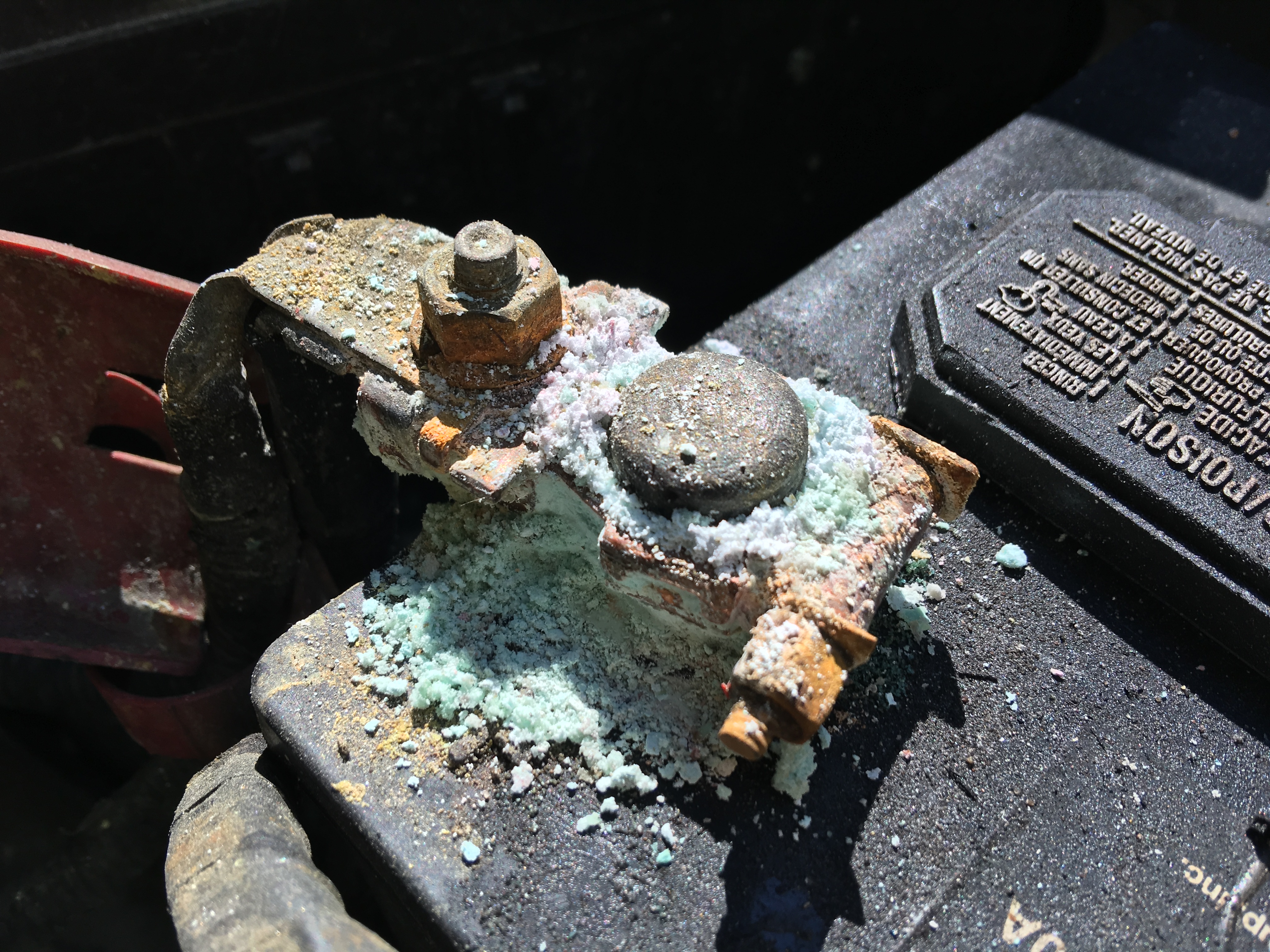
 and leaky batteries:

File:Battery Terminal Corrision.jpg
photo by MarkBuckawicki

but there are more insidious types of corrosion.

Oh, beware, my lord, of jealousy!
It is the green-eyes monster which doth mock 
The meat it feeds on.

says wise Iago, a man so corroded, and perhaps with jealousy, that his mind no longer even understands itself; and then there is the corrosion of greed, fear, hatred...

As with the more visible sorts of corrosion, they can almost all be cured; but, always, the sooner the owner takes action the better.

Thing Not To Do Today: corrode. This word comes from the Latin word corrōdere, to gnaw to pieces, from rōdere, to gnaw.


(This means it's basically the same word as rodent: and you wouldn't want rats in your brain, would you?)