This blog is for everyone who uses words.

The ordinary-sized words are for everyone, but the big ones are especially for children.


Friday, 31 May 2013

Word To Use Today: flummery.

Well, here's a lovely, gallumphing sort of a word.

Flummery.

Okay, basically flummery is cold porridge that's been allowed to go off (in the US I understand you say allowed to spoil); but only in a good way.

Or so they say.

For a classic flummery you need:

500g fine oatmeal, 1 litre water, 1 litre buttermilk, salt to taste.

Heat the water and buttermilk to body temperature, then pour it over the oatmeal, cover, and leave in a warm spot to ferment.

After three days (when the liquid will be sour) strain the mixture through muslin and discard the oats. Transfer the liquid to a large pan and bring to a boil. Continue cooking, stirring all the while, until the mixture thickens almost to the point of being solid and then season with salt.

Ladle into bowls, allow to cool until completely cold, pour over hot milk, and then - this is the problematic bit for me - I'm afraid you have to eat it.  

***

Still, never mind, there are other sorts of flummery. Flummery can be nonsense that's used to something to make something seem more important or interesting than it actually is.

Lastly, and most lovably, flummery can also mean harmless flattery. And even those who don't fancy a bowl of cold rancid porridge are bound to enjoy a little of that.

Word To Use Today: flummery. This word comes, like the recipe, from Wales. It's an English approximation of llymru.

Thursday, 30 May 2013

Every Little Helps.

They're out to get you.

Yes, there is now a Bad Grammar Award. It seems to have been started by Tom Hodgkinson.

Here's a passage from Toby Young's article about it in The Spectator of 11th May 2013.

"Another contender for the main prize was the text of a recent Tesco ad: ‘Enjoy the taste of England. Working with local producers to bring you a wider range of seasonal locally sourced products. Every little helps.’

The judges felt that ‘Enjoy the taste of England’ was just about acceptable, but thought the second sentence should have a comma after ‘seasonal’ and ‘locally sourced’ should be hyphenated to make it clear that ‘sourced’ is what is being qualified by the adverb ‘locally’. ‘Every little helps’, while a common phrase, is incorrect because ‘little’ is not a noun."

Okay then. Well, let's start from the beginning. 

Grammar is an attempt to analyse one aspect of the joyous thing we call language.

Very often (but not always), the purpose of language is to communicate an idea or fact.

If efficiently-communicating language fails to fit the rules of grammar, then who's to say it's the fault of the language, and not of the grammatical rules?

Well, the answer to that question is the people who think the grammatical rules are both right and sacrosanct. Unfortunately they are likely to be the people who run the world, or think they run the world, or think they ought to run the world.

Every little helps is a proverbial phrase that's been used for generations, and...

...oh, for heaven's sake!

Just invent some new rules!

OKAY?

Word To Use Today: little. This word comes from the Old English lȳtel and is related to lȳr, few, and the Old High German luzzil.

Wednesday, 29 May 2013

Nuts and Bolts: on the double.

Is it possible to make a list of twenty six words, each one  containing a different doubled letter of the alphabet?

(It was the lovely word screwworm that started me wondering.)

Well, let's see:

Aardvark, bobble, tobacco, waddle, dweeb, faff, gaggle, withhold, skiing, j (hm, I'll have to research that one) bookkeeping, loll, mummer, cunning, loon, popper, q (something Arabic?), barrage, rattle, vacuum, screwworm, x (someone must have made one up at some point, surely) y (um....), huzzah!

So, how about j, q, x and y? Well, apparently English has avijjā, huqqa and cubbyyew.

Avijjā is a Buddhist term for ignorance; a huqqa is an alternative spelling for a hookah; and a cubbyyew is a large sea fish, Elacate canada.

As far as I can discover from Those Who Know, though, there's no genuine double x word in English. Which is sad.

Never mind. I send this list to you with all best wishes, anyway,

xx

Sally

Tuesday, 28 May 2013

Thing To Do Today: clamber.

There are those who climb every mountain, but for the majority of us the most we ever do is have a bit of a clamber.

And what's wrong with that? For most of the time the top of a mountain is a much too windy, cold, and dangerous place for us to want to be.

Clambering may not be elegant or dignified, but it's good enough to get us somewhere that's free from the risk of flooding.

Clambering is the way a baby finds himself a nice comfy lap to sit on.

Clambering is the way to get to the very best rock pools.

Clambering is what you do when you can see the car, but reaching to it via the footpath is going to take you another twenty minutes.

It may not be athletic, it may not be pretty, but, oh, but the triumph of getting there in the end.

Thing To Do Today: clamber. This word has been around in English since the 1400s and is probably a version of the word climb, which is in turn related to the Old High German climban, which means to clamber.

This means, oh so neatly, that the meaning of clamber has been clambering around in a very slow circle.

There's an old meaning of clamber which means to cluster together, and this word may from the German klammer, which means to clutch or seize with claws.

That's quite a lot to do with our usual sort of clambering, too.


Monday, 27 May 2013

Spot the frippet: roller.

There's been a bit of excitement round here over the last day or two: a roller has turned up in Hampshire. (That's the English Hampshire.)

No, not one of these:


or one of these:


File:Fowler Steam roller sn 15981 of 1923.JPG
Photo by Bulldozer D11

or even one of these:

File:Paint roller 3.jpg
Photo by Erik bij de Vaate

No.

One of these:

File:European Roller.JPG
Photo by Gouldingken

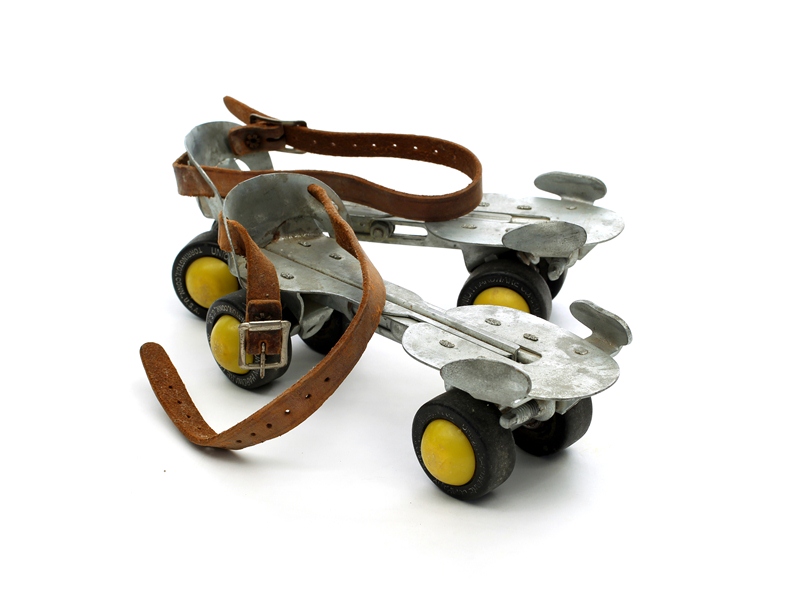
Rollers are quite unusual in England, so every bird-watcher who possibly can will be getting his skates on: 

File:The Childrens Museum of Indianapolis -Roller Skates.jpg
Photo by The Children's Museum of Indianapolis

and hoping the roller is still there when he (or she, but it's generally a he) arrives.

In short, their journey, dodging through the Bank Holiday traffic and hoping not to get news that the bird has flown, is bound to be a bit of a roller coaster.

File:Boomerang-rollercoaster.jpg
Photo by Chris Hagerman from New Port Richey Fl US

Ah well. If they miss it, there's always a good chance of seeing a pigeon. One like this:


is a roller, too, so-called because it does acrobatics as it flies.

And in Australia a roller is a man who packs sheep fleeces.

But I doubt it'll be the same.

Spot the frippet: roller. This word comes from the Old French roler, from the Latin rotulus, little wheel.


Sunday, 26 May 2013

Sunday Rest: Word Not To Use Today: genteel.

This word, as anyone can hear, is made of jelly.

Belch-flavoured jelly, at that.

Now, I realise I'm wasting my time, here, because visitors to The Word Den are all people of exquisite taste who would never think of using such a completely disgusting word as genteel in the first place, but just in case some tin-eared interloper has got in* then I suppose I should point out that, unless you want to show the world that you are extremely old-fashioned, have no taste, and are a snob, the word can have no place in your vocabulary.

The wretched word has an offshoot, genteelism: but, like all sane people, I wish it didn't.

Word Not To Use Today: genteel. This word comes from the French gentil, which means well-born, from the Latin gentilis, belonging to the same family, from gens, which means race.

*No, it's all right, you're very welcome anyway.

Saturday, 25 May 2013

Saturday Rave: Wit and Mirth by John Taylor.

John Taylor, in as much as he's remembered at all, is known as the Water Poet, but he was a working writer who wrote all sorts of stuff. I can't claim to have come across more than a handful of the jokes in his book Wit and Mirth, but some of them stand the test of time very well: in fact, some of them have been recycled endlessly to this day as new idiots come along for us to laugh at.

When Taylor's book came out in 1630 the people to laugh at were - but you'll soon see.

A nobleman (as he was riding) met with a yeoman of the country, to whom he said, 'My friend, I should know thee. I do remember that I have often seen thee.'

'My good lord,' said the countryman, 'I am one of your honour's good tenants, and my name is T.I.' 'I remember thee better now' (saith my lord) 'There were two brothers but one is dead. I pray, which of you does remain alive?'

And who would we be laughing at now?

Personally, I don't dare even make a suggestion.


Nobleman riding with a cheetah he has taken hunting by Rudolf Kleinpaul.

Word To Use Today: noble. This word comes from the Latin nōbilis, capable of being known, from noscere, to know.

By the way, I see that the nobleman met with the yeoman.

And I thought that met with was a new irritation...