This blog is for everyone who uses words.

The ordinary-sized words are for everyone, but the big ones are especially for children.


Saturday, 31 December 2016

Saturday Rave: The Darkling Thrush by Thomas Hardy

The obvious work to feature today is Robert Burns' Auld Lang Syne, a work traditionally sung on New Year's Eve, and which in its original form includes the phrase a right good willy waught, which adds considerably to the gaiety and bafflement of the season. (It's actually to do with drink.)

But, instead, here's a bit of Hardy. Thomas Hardy's brilliant at the countryside, and he's good at celebration, but there's a strong trail of melancholy running through his work that sometimes overwhelms the joy.

Here, you can almost see it happening: but it doesn't, quite.

I leant upon a coppice gate
When Frost was spectre-grey,
And Winter's dregs made desolate
The weakening eye of day.
The tangled bine-stems scored the sky
Like strings of broken lyres,
And all mankind that haunted nigh
Had sought their household fires.

The land's sharp features seemed to be
The Century's corpse outleant,
His crypt the cloudy canopy,
The wind his death-lament.
The ancient pulse of germ and birth
Was shrunken hard and dry,
And every spirit upon earth
Seemed fervourless as I.

At once a voice arose among
The bleak twigs overhead
In a full-hearted evensong
Of joy illimited;
An aged thrush, frail, gaunt and small,
In blast-beruffled plume,
Had chosen thus to fling his soul
Upon the growing gloom.

So little cause for carolings
Of such ecstatic sound
Was written on terrestrial things
Afar or nigh around,
That I could think there trembled through
His happy good-night air
Some blessed Hope, whereof he knew
And I was unaware.

*******************

Though how you can tell the age of a thrush from looking at it I have no idea at all. 

Perhaps it was wearing an age badge. 

Or a cardigan.


File:Song Thrush (Turdus philomelos) singing in tree.jpg
Photo of a Song Thrush by Taco Meeuwsen


Word To Use Today: thrush. This word is thrӯsce in Old English. Rather marvellously, it's related to the word throat.


Friday, 30 December 2016

Word To Use Today: Friday.

Friday. It's a Friday. 

Yes, I know it doesn't feel like a Friday, but it is.

As it happens, it's quite unusual that today is a Friday (no, I know they come round every seven days, but December 29th is more commonly a Tuesday, Thursday or Saturday. Or, indeed, a Sunday or Monday. Only Wednesday is as bad at being December 29th as a Friday. This must be true because it says so on Wikipedia, but I do not pretend to understand it).

Friday is an important day for many religions of the world, some faiths feasting and some fasting, but I must just note that in Thailand Friday is blue. (I don't understand this, either.)

Some Fridays are famously unlucky, though Good Friday is supposed to be the best day for sowing your parsley.

Particularly enchanting is the report that the goddess after whom Friday is named used to (and perhaps still does) spin the clouds.


painting by John Charles Dollman

Isn't that lovely?

Word To Use Today: Friday. This word comes from the Old English Frīgedæg, day of Frige. Frige is rather like the goddess Venus, after whom Fridays in France, for example, are named.


Thursday, 29 December 2016

The Tyranny of Bowls: a rant.

Being mildly bullied by the Government, the forces of the Law, criminals, social media, and, of course, our dear friends and family, is, sadly, inevitable.

There's no need, though, for us to put up with being bullied by inanimate objects. Plates, particularly. Or bowls. 

Mugs are possibly the worst culprits of all.

What's the point of having a plate which instructs us by the means of a message on its rim to fill it with PASTA?

And there's no ignoring these inscriptions, is there. I mean, eating a rice pudding in a bowl marked SOUP is going to skew the eating experience bewilderingly towards a risotto, however strong-minded we are.

Consider the utter olfactory confusion of drinking tea out of a COFFEE mug; or the horrid disappointment of a healthy green salad served on a plate labelled EGGS & BACON.

Still, I felt vindicated the other day. I was sent a catalogue from the china company Emma Bridgewater.

The picture of their lettered 'Black Toast' French Bowl couldn't show all the letters of the circular legend PORRIDGE...

...so all it said was ORRID.

Quite right, too.

Word To Use Today: horrid. This word meaning unpleasant comes from the Latin horridus, prickly or rough, from horrēre, to bristle.


Wednesday, 28 December 2016

Nuts and Bolts: the language of the arctic.

What do polar bears sing on holidays?

Freeze a jolly good fellow...

Okay, okay, sorry, not really. Well, what with the body language, the chuffs and the scent markings they don't have to.


photo taken by Ansgar Walk, CC BY 2.5, https://commons.wikimedia.org/w/index.php?curid=905192

For instance, if a polar bear wants to play with you it might wag its head from side to side, or it might stand up, paws by its sides and chin lowered onto its chest. (Mind you, 'playing' usually involves a mock battle, so I wouldn't hang around in the hope of a nice quiet game of monopoly. And if it does want to play monopoly, I'd let it win.)

If a polar bear calls hoping for a meal, he will approach slowly, circle around the food, and then do a gentle nose-to-nose kiss. How spookily human is that?

Polar bears chuff when they're worried; hiss and snort and lower the head as a threat; roar when angry; and growl in warning, which, when you come to think about it, is all pretty human, too.

If a polar bear wants to avoid annoying a larger bear, he will always stay down-wind of him. 

This is not very human behaviour, though I can't help feeling it should be.

Lastly, no one is quite sure about this, yet, but it's thought that bears might attract their mates by leaving a trail of scent. In the bears' case the scent is caused by their smelly feet. 

But, hey, the principle is human enough, isn't it?

Word To Use Today: arctic. This word comes from the Latin arcticus, from the Greek arktikos, northern (literally: of the [constellation of the] bear, from arktos, bear).


Tuesday, 27 December 2016

Thing To Do Today: curry something.

Well, we've had our roast turkey/chicken/goose, we've eaten it cold the next day, and now, quite frankly, we'd be rather relieved if the cat stole it.

But sadly even the cat is turning up its delicate nose at the drying strings of meat attached to the carcase, and so we're going to have to give the stuff a jolly good currying.

File:Cashew Curry.JPG
photo by Prasadsovani

Onions, ginger, garlic, cumin, coriander, chilli; then whatever else you happen to fancy - coconut, tomatoes, cream, cashews; then more coriander (fresh this time); your cold meat or left-over veggie roast; and then suddenly the scent of it all is bringing everyone hurrying to sit down with a new and hearty appetite. 

What else can you curry? Goat; potatoes; a rug (this will not involve onions, obviously, but rather beating it briskly to clean it); leather (you curry leather after the tanning process to make the stuff flexible and waterproof); favour (where you are very very nice to someone with money or power); or a horse (which might involve onions etc, but will probably be part of its grooming routine).

And then what?

Then, heaven help us, we start thinking about food for the blessed New Year.

Thing To Do Today: curry something. The food word comes from the Tamil kari, which means sauce or relish. All the other meanings comes from the Old French correer, to make ready.


Monday, 26 December 2016

Spot the Frippet: tip.

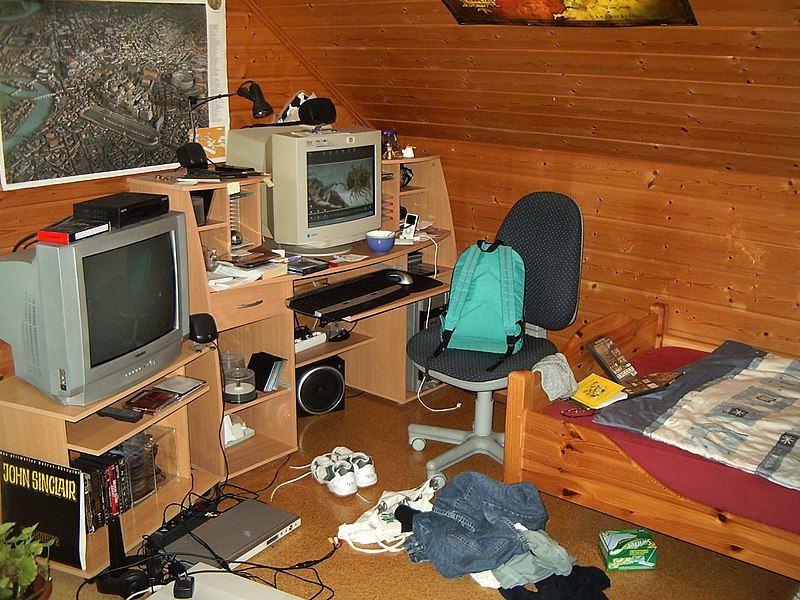
Today in Britain today is Boxing Day, when traditionally tradesmen are given a present of money. This present is called a Christmas Box, but during the rest of the year, of course, it's called a tip, which makes a nice easy thing to spot after the rigours of Christmas.

To make things even easier, tip is really four words. There's the sort of tip that's the far end of something, like a finger, or a mountain, or a knitting needle; there's the tip that's a payment given for services rendered (in Britain it's usually 10%, and only given if you get good service); there's the light/glancing blow tip, such as one might make when playing cricket; and (also in Britain) there's a rubbish dump tip where refuse has been, well, tipped.

This last meaning is widely and commonly transferred: a student's untidy room is a tip. 

File:Untidy room.JPG

This is vastly satisfying to point out, and I recommend it to friends throughout the world.

Spot the Frippet: tip. The end-of-something word comes from the Old Norse typpa; the dumping word is rather mysterious, but is related to topple, which comes from the Old Norse toppr, tuft; the hitting word is also mysterious, but might comes from the Low German tippen; and the payment-for-services word is probably related to tippen, too.


Sunday, 25 December 2016

Sunday Rest: nice. Word Not To Use Today.

Well, here's a challenge for us all on Christmas Day: avoiding the use of the word nice.

Mnd you, the great Henry Tilney, of Northanger Abbey, has a lot of fun with it.

'But now really, [Catherine asks him] do not you think Udolpho the nicest book in the world?'
'The nicest - by which I suppose you mean the neatest. That must depend upon the binding.'
'Henry,' said Miss Tilney [that's Henry's sister], 'you are very impertinent'...
'I am sure,' cried Catherine, 'I did not mean to say anything wrong; but it is a nice book, and why should I not call it so?'
'Very true,' said Henry, 'and this is a very nice day, and we are taking a very nice walk, and you are two very nice young ladies. Oh! It is a very nice word indeed! - It does for everything. Originally perhaps it was applied only to express neatness, propriety, delicacy, or refinement - people were nice in their dress, in their sentiments, or their choice. But now every commendation on every subject is comprised in that one word.'
'While, in fact,' cried his sister, 'it ought only to be applied to you, without any commendation at all. You are more nice than wise.'

Now, Isabella was of course quite right to tell Henry he is impertinent, but Henry was also right to point out that the poor word nice does for everything. It must be one of the laziest words in the language, and today of all days, which will see the results of a great deal of effort, it should be very firmly banned.

The potatoes, pudding, pies and presents are not nice. Neither is the cake, the sherry, or the paper hat. 

So just make a bit of an effort, okay? The parsnips are admirable, excellent, first-class, perfect, fabulous, splendid, magnificent, marvellous, sensational, superb, wonderful, gorgeous, lovely, heavenly, capital or possibly even top-notch.

Anything, almost anything, but nice.

Happy Christmas!

Word Not To Use Today: nice. This word arrived in English in the 1200s, when it meant foolish. It comes from the Old French nice, simple or silly, from the Latin nescius, ignorant.